
1896 Educational Series Silver Certificates: The Story Behind America’s Most Famous Paper Money
"History Instructing Youth" and the rest of the 1896 Educational Series — how to identify the $1, $2, and $5, and why the tape still matters.
Few pieces of American paper money are as recognizable—or as visually impressive—as the 1896 Educational Series Silver Certificates.
If you've ever seen an old U.S. note covered in elaborate artwork, allegorical figures, classical imagery, and portraits of famous Americans, there's a good chance you've encountered one of these remarkable certificates.
The series consists of just three denominations: $1, $2, and $5.
Today, collectors commonly call them the Educational Series because of the educational theme and, particularly, the famous $1 design known as “History Instructing Youth.” The Smithsonian describes the series as among the most beautiful American notes ever printed.
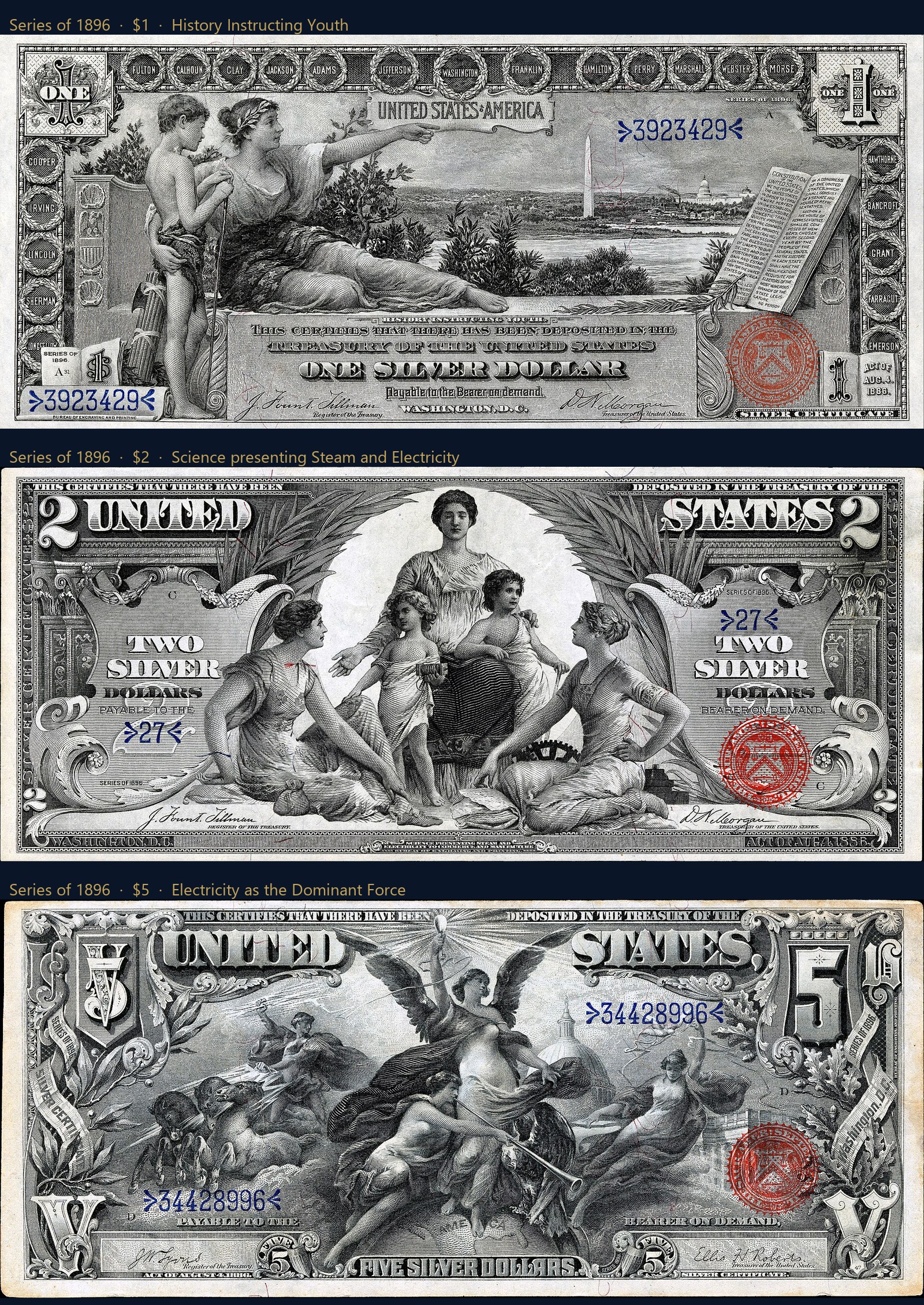
Series of 1896 $1, $2, and $5 Silver Certificates. Public domain, National Numismatic Collection.
But these notes aren't interesting simply because they're beautiful.
They represent a fascinating moment in American history, when the United States was debating the role of silver, experimenting with the visual language of its currency, and attempting to make something as ordinary as money communicate a larger story about American history, science, industry, and progress.
And if you happen to own one, there's another question that probably matters even more:
What is an 1896 Educational Series Silver Certificate worth?
The answer depends on exactly which note you have, its condition, and other characteristics.
Let's take a closer look.
What Is the 1896 Educational Series?
The 1896 Educational Series was a group of United States Silver Certificates issued in three denominations:
- $1 Silver Certificate
- $2 Silver Certificate
- $5 Silver Certificate
The notes were part of the Series of 1896 and were authorized under the silver certificate legislation of the late 19th century. The Bureau of Engraving and Printing produced the notes, which were substantially larger than modern U.S. currency.
The Smithsonian's National Museum of American History identifies the $1, $2, and $5 notes as the Educational Series and describes their designs as neoclassical.
Unlike today's relatively restrained paper money designs, these certificates were packed with imagery.
They look more like miniature works of art than the bills Americans carry in their wallets today.
And that was essentially the point.
The designs were intended to communicate ideas through art.
Why Are They Called the “Educational Series”?
The nickname comes primarily from the design of the $1 note.
Its central scene is titled:
“History Instructing Youth.”
The composition shows an allegorical female figure representing History teaching a young child. Behind them is the Washington, D.C., skyline, including the U.S. Capitol and Washington Monument. The scene also incorporates the U.S. Constitution.
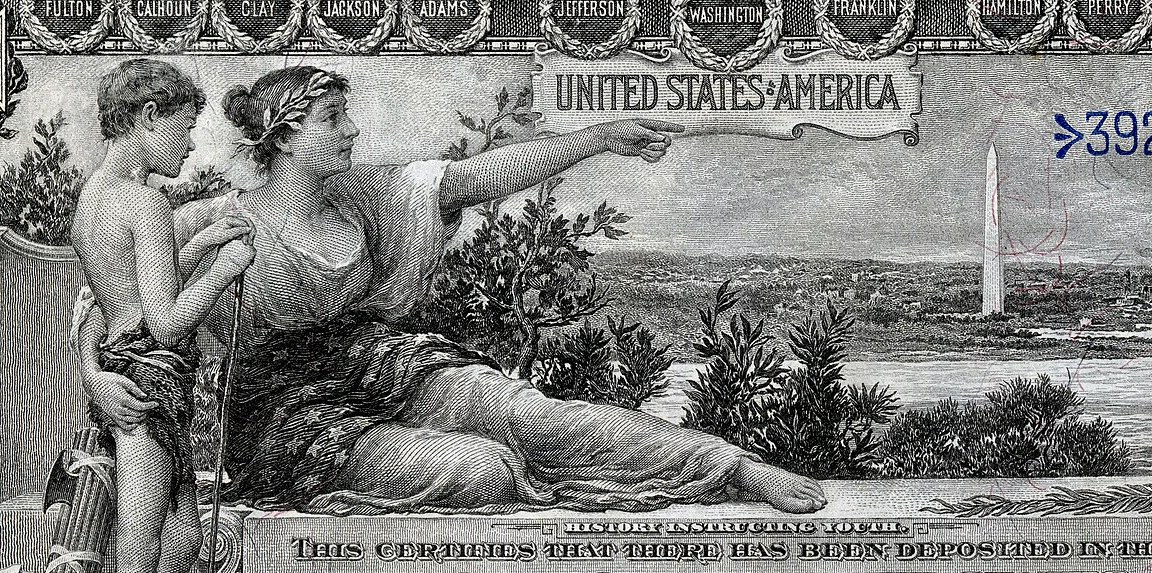
History Instructing Youth, the central vignette on the 1896 $1.
The idea was that the imagery on the currency itself could teach the person holding it.
That concept was unusual.
Rather than simply putting a portrait of a president on the front of the note, the designers created a visual lesson.
The result was one of the most elaborate pieces of American currency ever produced.
The other two denominations continued the educational theme through science, technology, commerce, manufacturing, and American military history.
The 1896 $1 Silver Certificate
The $1 (Fr. 224) is probably the most famous note in the series. Fr. 225 is the same design with the Bruce–Roberts signatures. Martha Washington is on the back of both; the portrait story is Martha Washington on U.S. currency.
Its central design, History Instructing Youth, is one of the most recognizable images in American paper-money collecting.
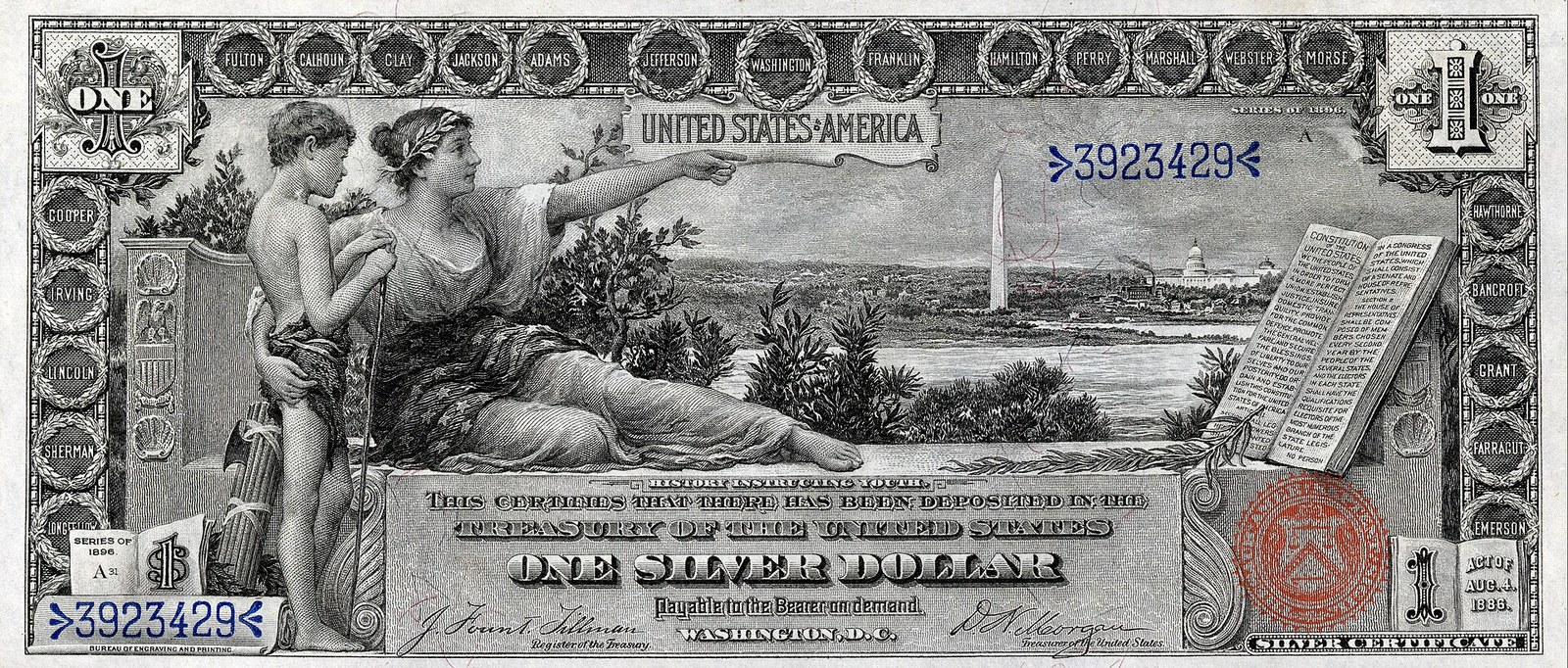
The female figure represents History.
She sits beside a young child and points toward a representation of the Constitution while the Washington Monument and U.S. Capitol appear in the background.
The design is filled with additional details.
Around the main image are wreaths containing the names of notable Americans, adding another layer to the educational theme.
This wasn't accidental decoration.
The designers wanted the note to celebrate American history and the country's intellectual, political, and technological development.
Martha and George Washington
Turn the note over and you'll find another remarkable feature.
The reverse features portraits of George Washington and Martha Washington.
Martha Washington is particularly significant because she is one of the few women ever depicted on U.S. paper currency.
For collectors who have never seen an Educational Series note before, the combination of the elaborate front and the Washington portraits on the back can make the $1 almost immediately recognizable.
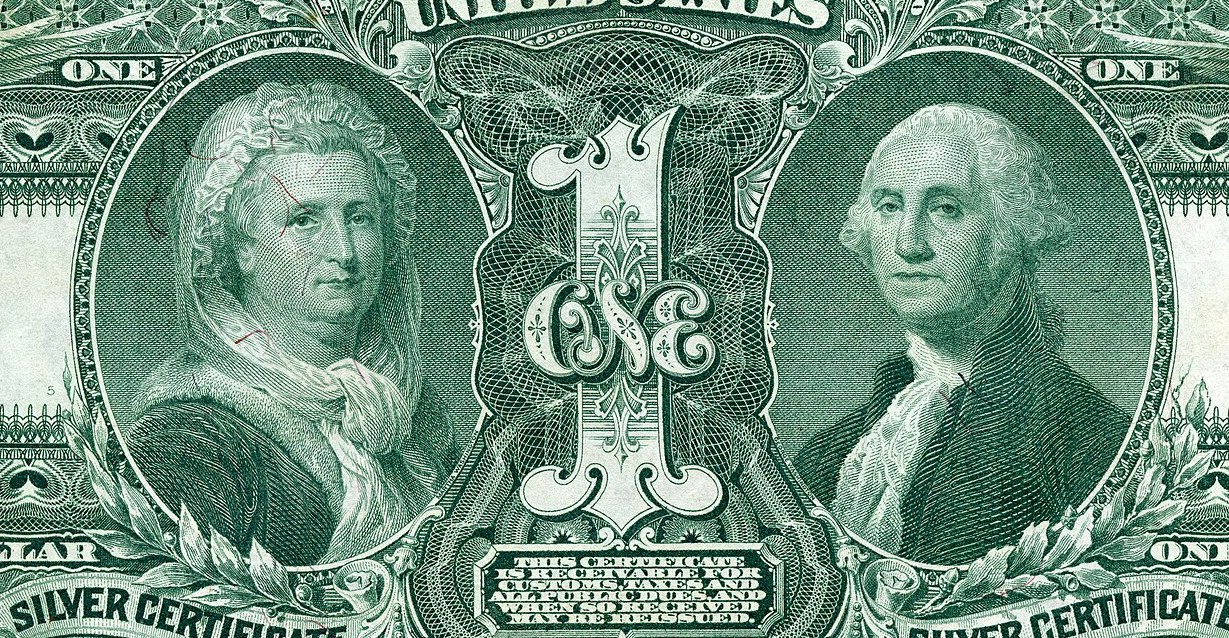
Reverse portraits of Martha and George Washington on the 1896 $1.
The 1896 $2 Silver Certificate
The $2 (Fr. 247) takes the theme in a different direction. Fr. 248 is the Bruce–Roberts pair.
Its central scene is titled:
“Science Presenting Steam and Electricity to Commerce and Manufacture.”
The design depicts allegorical figures representing Science, Steam, Electricity, Commerce, and Manufacture.
The imagery reflects the enormous technological and industrial changes taking place in the United States during the late 19th century.
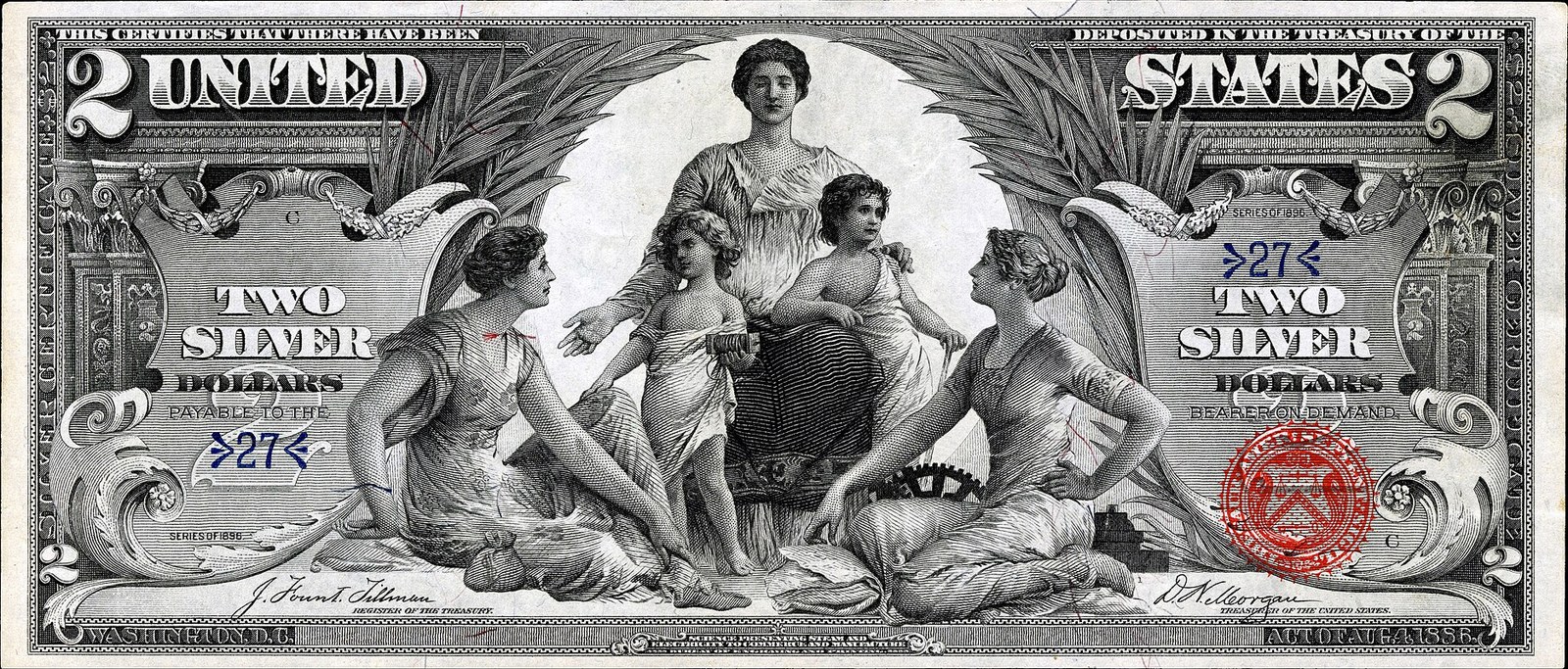
Steam and electricity were transforming transportation, manufacturing, communications, and everyday life.
The note essentially turns those forces into characters.
Science introduces them to Commerce and Manufacture, creating a visual representation of technological progress.
It's a fascinating snapshot of how Americans viewed the future at the end of the 19th century.
Robert Fulton and Samuel Morse
The reverse features portraits of two important figures in American technological history:
Robert Fulton and Samuel F. B. Morse.
Fulton is associated with the development of commercially successful steamboat transportation.
Morse is famous for the telegraph and Morse code.
Their inclusion reinforces the $2's central message about science, technology, communication, and industry.
The entire note functions almost like a visual poster celebrating technological progress.
The 1896 $5 Silver Certificate
The $5 (Fr. 268) takes the series into another area of American progress. Fr. 269 is Bruce–Roberts. Fr. 270 is Lyons–Roberts.
Its central design features Electricity as the dominant allegorical figure.
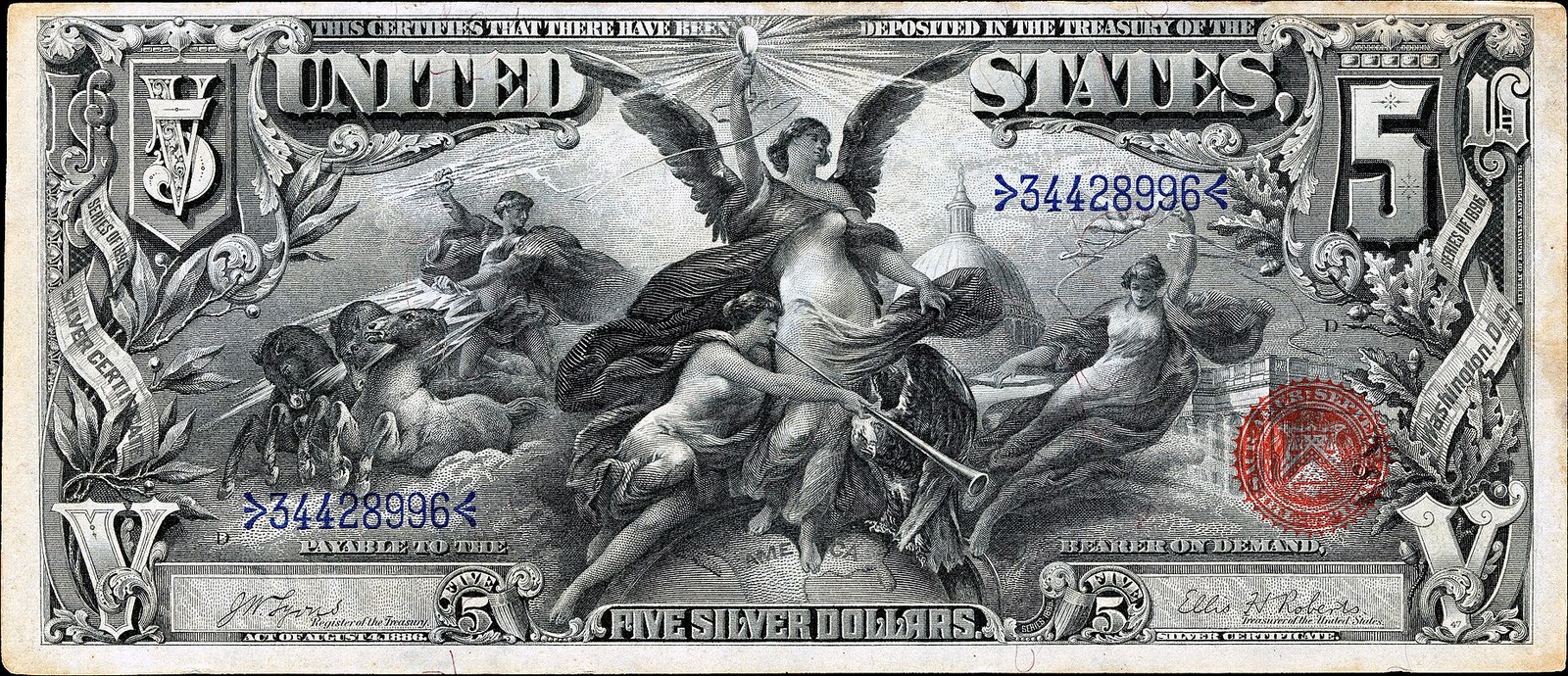
The imagery is dramatic.
Electricity is presented as a powerful force, reflecting the growing importance of electrical technology at the end of the 19th century.
The note's design is therefore a continuation of the same broad idea seen on the $2:
America is advancing through science and technology.
But the $5 has a distinctly different character from the $1.
The $1 looks back toward American history.
The $2 focuses on science and industry.
The $5 presents electricity as a powerful force shaping the future.
Grant and Sheridan
The reverse features two famous Civil War figures:
Ulysses S. Grant and Philip Sheridan.
That gives the $5 another connection to American history, tying the series' futuristic imagery back to the country's recent past.
Why Do the Notes Look So Different From Modern Money?
Put an 1896 Educational Series note next to a modern Federal Reserve Note and the difference is enormous.
The Educational Series notes were approximately 7.3 to 7.4 inches long, depending on the specific note. The Smithsonian examples measure roughly 18.8 to 18.8 centimeters in length.
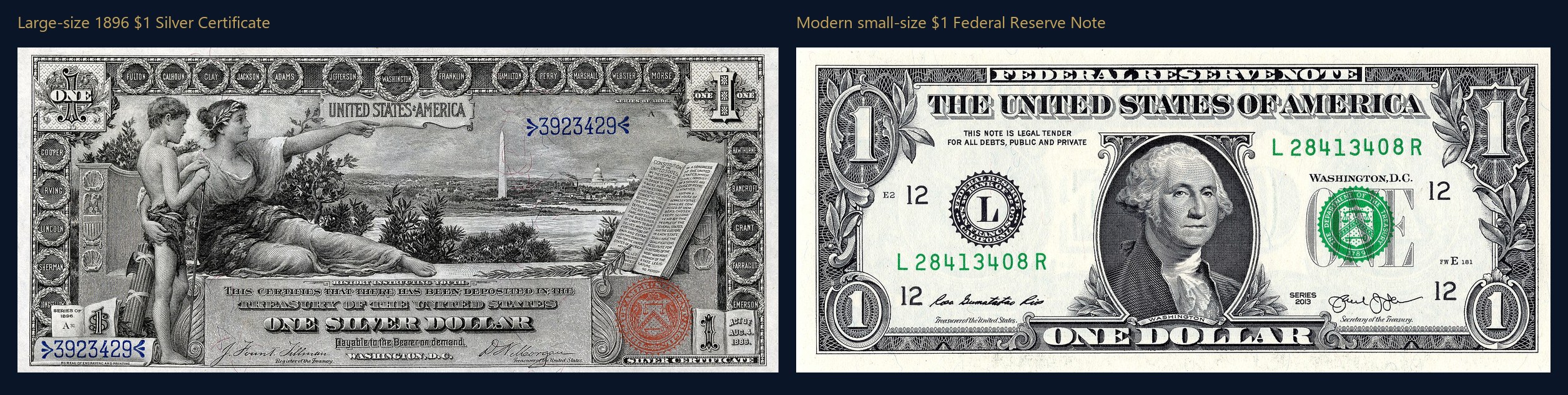
Large-size 1896 $1 beside a modern small-size $1. Both designs are public domain.
They were also produced using elaborate engraved designs.
Instead of large blocks of empty space, the notes are filled with:
- Allegorical figures
- Portraits
- Wreaths
- Classical architecture
- Decorative borders
- Text
- Symbols
- Fine engraved lines
The result is visually dense.
In fact, one reason the series is so admired today is precisely because of that density and craftsmanship.
The Artwork Behind the Money
The Educational Series is unusual because its imagery wasn't created simply as generic currency decoration.
The designs drew from established artistic traditions and paintings.
The $1's History Instructing Youth design was adapted from artwork by American artist Will H. Low.
The $2's central design was created around the work of Edwin H. Blashfield, with engraving work translating the artwork into a form suitable for currency.
This helps explain why the notes can look so different from other American currency.
The designers weren't merely arranging portraits and denominations.
They were adapting artwork into engraved currency.
That was an ambitious experiment.
Why Were Such Elaborate Designs Put on Money?
The late 19th century was a period of enormous change in the United States.
Industrialization was accelerating.
Electricity was becoming increasingly important.
Railroads were connecting the country.
The telegraph had transformed communication.
American industry was expanding.
At the same time, the country was deeply divided over monetary policy, particularly the role of silver.
The Educational Series emerged from that broader environment.
Its imagery presented an optimistic vision of American knowledge, industry, science, and progress.
The Smithsonian has noted that the government viewed the new designs as having an educational and nation-building purpose.
In other words, the government wasn't simply printing money.
It was using money as a tiny billboard for American ideals.
The Problem With Beautiful Money
There was just one problem.
People actually had to use these things.
And elaborate artwork isn't necessarily convenient when you're trying to count thousands of dollars quickly.
Contemporary criticism focused on the complexity of the designs.
The detailed engraving could become difficult to read once notes became dirty or worn, and some of the design elements created practical problems for people handling currency.
There were also concerns about counterfeiting and the difficulty of distinguishing some design elements.
The $1's large numeral, for example, was eventually modified in later treatments partly to make the denomination more immediately recognizable.
So while collectors today admire the Educational Series for its artistic complexity, the people who had to count the notes all day weren't necessarily as enthusiastic.
How Rare Are 1896 Educational Series Notes?
This is where things get interesting for collectors.
The Educational Series consists of only three regular denominations, making a complete set relatively straightforward in terms of the number of different designs:
$1 + $2 + $5
But that doesn't mean every example is equally scarce.
There is a major difference between:
How many were originally printed
and
How many survive today in a particular condition.
Collectors also distinguish between different varieties, signature combinations, serial numbers, grades, and other characteristics.
And because these are 19th-century notes, condition can make a dramatic difference.
A heavily circulated example and a crisp, high-grade example can occupy completely different parts of the market.
What Is an 1896 Educational Series Silver Certificate Worth?
This is the question that usually brings collectors to the subject.
Unfortunately, there is no single price for an “1896 Educational Series note.”
The exact value depends on the specific denomination and characteristics of the note.
The first step is identifying which note you actually have.
Is it:
- 1896 $1?
- 1896 $2?
- 1896 $5?
Then you need to look more closely.
Condition matters
A note that has been folded repeatedly, stained, torn, repaired, or otherwise damaged will generally be treated differently from a crisp, well-preserved example.
Look closely at:
- Folds
- Creases
- Tears
- Edge damage
- Pinholes
- Stains
- Writing
- Repairs
- Missing corners
- Paper quality
- Overall sharpness
Do not attempt to improve the appearance of an old note yourself.
Don't wash it.
Don't iron it.
Don't tape it.
Don't trim it.
Don't try to flatten it.
What looks like an improvement to an inexperienced owner can permanently damage collectible paper money.
Serial Numbers Matter Too
The serial number is another important piece of information.
When identifying an Educational Series note, record the entire serial number exactly as it appears.
Also note any letters, symbols, or unusual characteristics surrounding it.
A photograph of the serial number can be particularly useful when researching a specific note.
This is one reason a photograph is often more useful than simply telling someone:
“I have an 1896 $1 Silver Certificate.”
That's a starting point—not a complete identification.
What About Signature Combinations?
Older U.S. currency often carries the names or signatures of Treasury officials.
These combinations can be important to collectors because they help distinguish one issue from another.
So when you're trying to identify an 1896 Educational Series note, don't ignore the smaller text.
A complete identification may require looking at:
- Denomination
- Series
- Serial number
- Signatures
- Treasury seal
- Design
- Condition
- Other identifying features
That is why two notes that appear nearly identical at first glance may not actually be identical collectible items.
How to Tell Which Educational Series Note You Have
If you're holding one right now, identification can be surprisingly easy.
Step 1: Look at the denomination
The Educational Series contains three regular denominations:
$1, Fr. 224, $2, Fr. 247, and $5, Fr. 268. Signature pairs of the same design are separate catalog numbers.
Step 2: Look for “Series of 1896”
The series designation should identify the note as part of the 1896 issue.
Step 3: Examine the main artwork
If you see History Instructing Youth, you've got the $1.
If you see Science Presenting Steam and Electricity to Commerce and Manufacture, you've got the $2.
If you see the allegorical figure of Electricity, you've got the $5.
Step 4: Turn it over
The reverse can provide another confirmation.
$1: George and Martha Washington
$2: Robert Fulton and Samuel Morse
$5: Ulysses S. Grant and Philip Sheridan
Step 5: Photograph the note
Take a clear photograph of both sides.
Then photograph any details that aren't easy to read in the full image.
This gives you the information needed to research the specific note rather than simply researching “old Silver Certificates.”
Don't Confuse the 1896 Series With Other Old Silver Certificates
This is an important distinction.
The 1896 Educational Series is only one group within the much larger history of U.S. Silver Certificates.
There are many other Silver Certificate series from the late 19th and 20th centuries.
Some are common.
Some are scarce.
Some have unusual designs.
Some have interesting serial numbers.
Some are valuable because of their condition.
And some are valuable because they're genuinely rare.
That's why the phrase “1896 Silver Certificate” is useful—but it isn't necessarily enough to determine a market value.
Why Collectors Love the Educational Series
There are plenty of old U.S. notes.
There are also plenty of rare U.S. notes.
But the Educational Series occupies a special place because it combines several things collectors find appealing.
History
These notes were produced during a fascinating period in American monetary history.
Art
The designs are dramatically different from the utilitarian appearance of modern currency.
Technology
The $2 and $5 notes celebrate science, industry, and electricity.
Famous Americans
The reverses feature people such as Washington, Fulton, Morse, Grant, and Sheridan.
Rarity
These are 19th-century collectible notes that have survived for more than a century.
Collectibility
There are only three regular denominations in the series, making the idea of assembling a complete set especially appealing.
It's hard to look at these notes and not understand why they have remained popular.
The Complete 1896 Educational Series
If you're building a collection, the basic set is simple:
| Denomination | Main Design | Reverse |
|---|---|---|
| $1 | History Instructing Youth | George & Martha Washington |
| $2 | Science Presenting Steam and Electricity to Commerce and Manufacture | Robert Fulton & Samuel Morse |
| $5 | Electricity | Ulysses S. Grant & Philip Sheridan |
The Smithsonian's National Museum of American History has examples of all three denominations in its National Numismatic Collection.
But collecting the three basic designs is only the beginning.
Collectors can become much more specialized when they begin examining condition, varieties, proofs, and other related material.
More Than Three Notes?
Yes.
Although the regular circulating Educational Series consists of the $1, $2, and $5, collectors can encounter other related material connected with the series.
This can include proofs, essays, progressive proofs, and other pieces created during the design and production process.
The American Numismatic Society notes that its collection includes an 1896 $1 Educational Series Silver Certificate and describes the series as especially notable for having face designs adapted from paintings.
Specialized collections can therefore go far beyond simply finding one of each denomination.
For most people discovering an Educational Series note, however, the first question is much simpler:
What exactly do I have?
What If I Found One?
If you've inherited, purchased, or discovered an 1896 Educational Series Silver Certificate, don't assume you know its value just because you recognize the design.
Start by identifying the note.
Take photographs.
Record the denomination.
Record the serial number.
Look at the condition.
Then research actual comparable sales.
This last step is important.
Asking Price vs. Sale Price
You can search the internet and find old paper money listed for almost any price.
But a listing isn't proof that someone paid that amount.
A seller can ask $1,000 for a note.
That doesn't make the note worth $1,000.
For understanding the market, completed sales are much more useful than optimistic asking prices.
When researching an 1896 Educational Series note, try to find sales of notes that match as closely as possible.
Ideally, compare:
- Same denomination
- Same series
- Similar condition
- Similar certification
- Similar varieties
- Similar serial-number characteristics
The closer the comparison, the more useful the result.
Should You Have an 1896 Educational Series Note Graded?
Potentially.
Because these notes can be collectible and valuable, professional authentication and grading may make sense for the right example.
But grading isn't automatically worthwhile for every note.
If the note is heavily circulated and relatively common within its market, grading costs may not make sense.
If you have an exceptionally well-preserved example, a rare variety, or a note with significant potential value, professional certification may be much more useful.
Before spending money on grading, first figure out what you're actually holding.
The Educational Series and the Story of American Money
The most interesting thing about the 1896 Educational Series may not be its value.
It may be what the notes tell us about the United States in 1896.
America was looking backward at its history while racing toward the future.
The $1 literally depicts History teaching the next generation.
The $2 celebrates science, steam, electricity, commerce, and manufacturing.
The $5 places electricity at the center of its design.
And the reverses bring in famous Americans from politics, war, science, communication, and exploration.
The three notes tell a surprisingly coherent story.
History.
Science.
Industry.
Progress.
All printed on money.
Why the 1896 Educational Series Still Matters
More than a century after they were printed, the Educational Series remains one of the most recognizable chapters in American paper-money history.
These notes demonstrate just how different money once looked.
They also show that currency can be much more than a medium of exchange.
It can be:
- Art
- History
- Technology
- Politics
- Culture
- Collecting
- Investment
- A physical record of its time
And that's what makes old paper money so interesting.
You aren't just holding an old dollar.
You're holding something that people actually used, carried, deposited, saved, and spent more than a century ago.
How Much Is Your 1896 Educational Series Note Worth?
If you have an 1896 $1, $2, or $5 Silver Certificate, the next step isn't guessing.
It's identification.
Start with the note itself.
What denomination is it?
What series is it?
What is the serial number?
What condition is it in?
Are there varieties or other characteristics that matter?
And most importantly:
What have comparable examples actually sold for?
On Rarity Ledger that question is a catalog match you confirm — search or a photo — and then the auction lots joined to that ID. The $1, the $2, and the $5 are three different pages. Buy It Now prices on auction sites, including eBay, are included. Retail and dealer shop prices are not. If a grade has no comps, the page does not invent them.
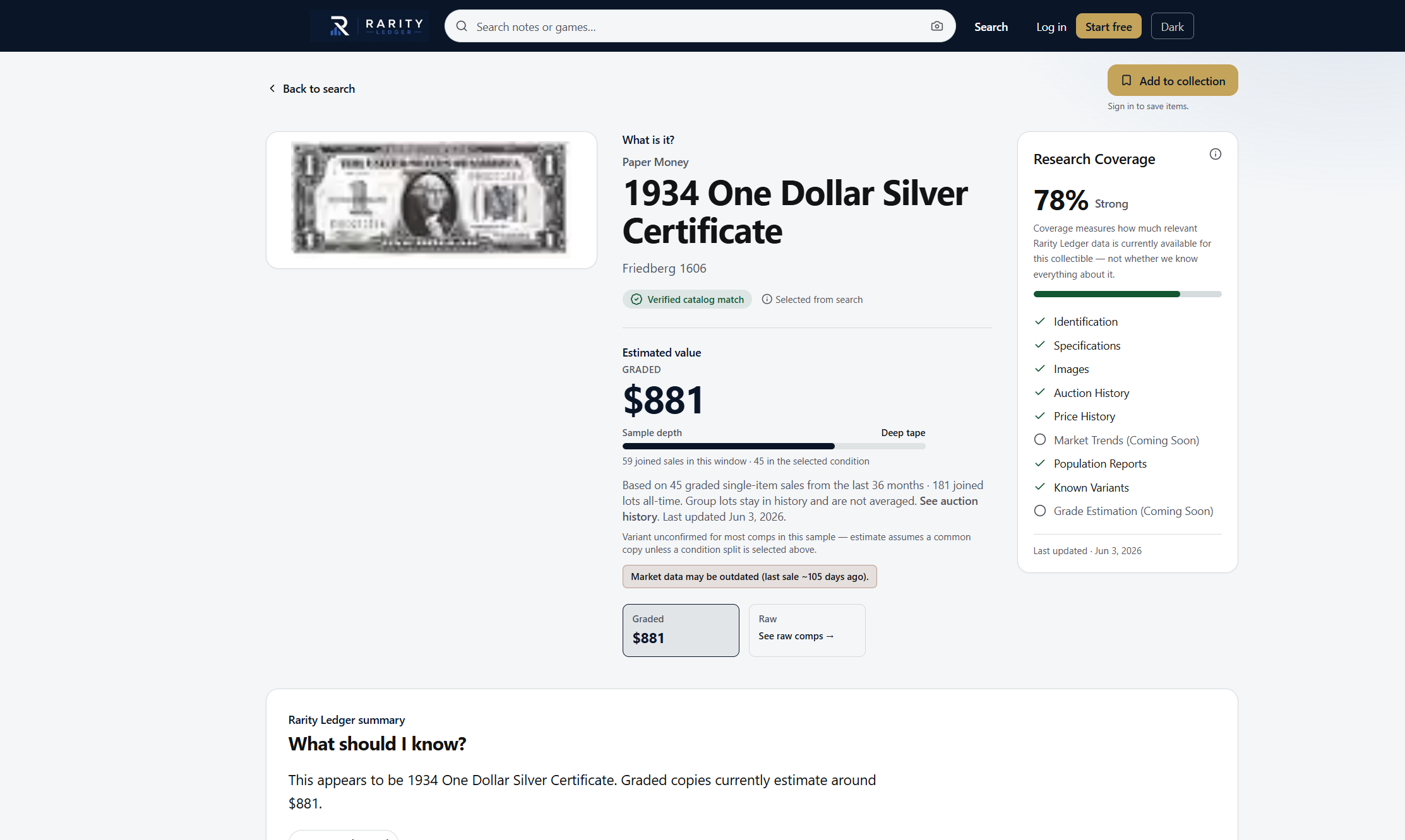
An item page: the catalog identity first, then joined auction sales. This screenshot is a Silver Certificate decision page, not a picture of the 1896 note itself.
If you have one sitting in a collection, an old album, a safe, or an inherited box of currency, don't judge it by the artwork alone. Identify the denomination and the signature pair, then read the sales for that note.
Image credits
U.S. currency images are public-domain works of the United States government (Bureau of Engraving and Printing), reproduced from Wikimedia Commons and the National Numismatic Collection at the Smithsonian Institution. Product screenshots are original to Rarity Ledger.