
Martha Washington on U.S. Currency: The Story Behind the Silver Certificate
How to tell the 1886, 1891, and 1896 Martha Washington notes apart — and why the portrait is only the start of identification.
Look closely at an old U.S. Silver Certificate and you may notice something unusual.
Not George Washington.
Not Abraham Lincoln.
Not Alexander Hamilton.
Martha Washington.
Her portrait appeared on U.S. paper currency in a way no other historic woman has matched. Martha Washington appeared on the $1 Silver Certificate in the 1886 and 1891 series, and she appeared again on the back of the $1 Silver Certificate in the 1896 Educational Series. The U.S. Currency Education Program identifies these as the Silver Certificate issues featuring Martha Washington.
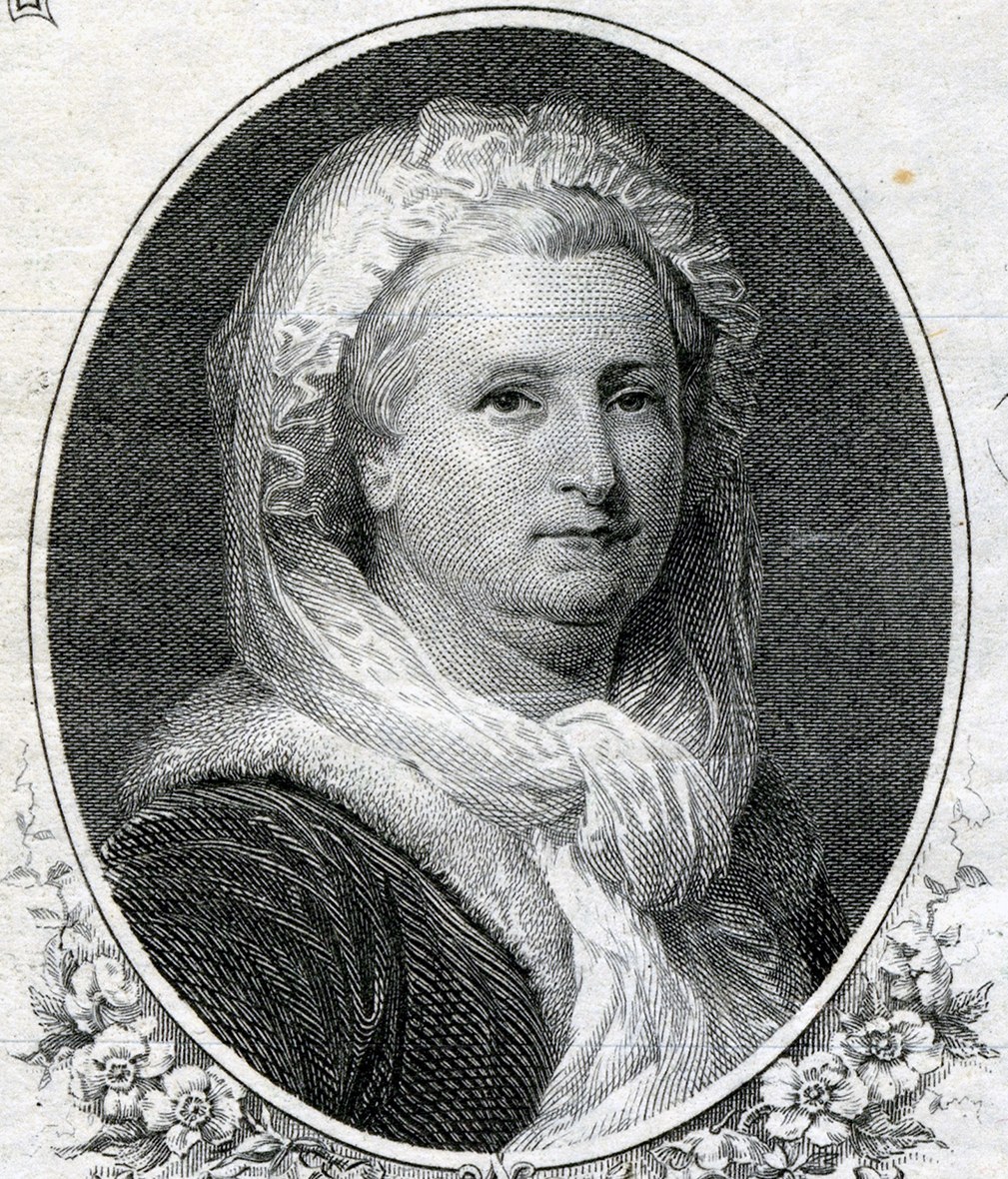
Martha Washington, from a U.S. Silver Certificate. Public domain.
That makes these notes some of the most interesting pieces of American paper money ever produced.
But if you have one, there's a bigger question:
How much is a Martha Washington Silver Certificate worth?
The answer depends on exactly which note you have.
Why Is Martha Washington on U.S. Currency?
Martha Washington was the wife of George Washington, the first President of the United States.
But her appearance on American currency wasn't simply an attempt to honor her as a First Lady.
During the late 19th century, American paper money looked very different from the currency we use today.
The government was experimenting with elaborate designs, allegorical artwork, historical figures, and symbolic imagery.
Silver Certificates were particularly suited to this experimentation.
The first Silver Certificates were authorized in 1878, and Congress later authorized $1, $2, and $5 Silver Certificates in 1886. The certificates allowed people to use paper as a more convenient representation of silver held by the Treasury rather than carrying large quantities of silver coins.
And in 1886, Martha Washington became part of that story.
Martha Washington Was the First Woman Featured on U.S. Paper Currency
Martha Washington holds a unique place in American currency history.
According to the U.S. Currency Education Program, $1 Silver Certificates featured Martha Washington in the 1886 and 1896 series.
The Smithsonian also identifies Martha Washington on the 1886 and 1891 $1 Silver Certificates.
That makes an important distinction:
Martha Washington appeared on multiple Silver Certificate issues, not just one.
Collectors therefore shouldn't simply search for:
“Martha Washington dollar”
and assume every result represents the same note.
There are different designs and series to identify.
The 1886 Martha Washington Silver Certificate
The first Martha Washington Silver Certificate is the 1886 $1. Fr. 215 is the Rosecrans–Jordan combination. Later 1886 signature pairs are their own catalog numbers.
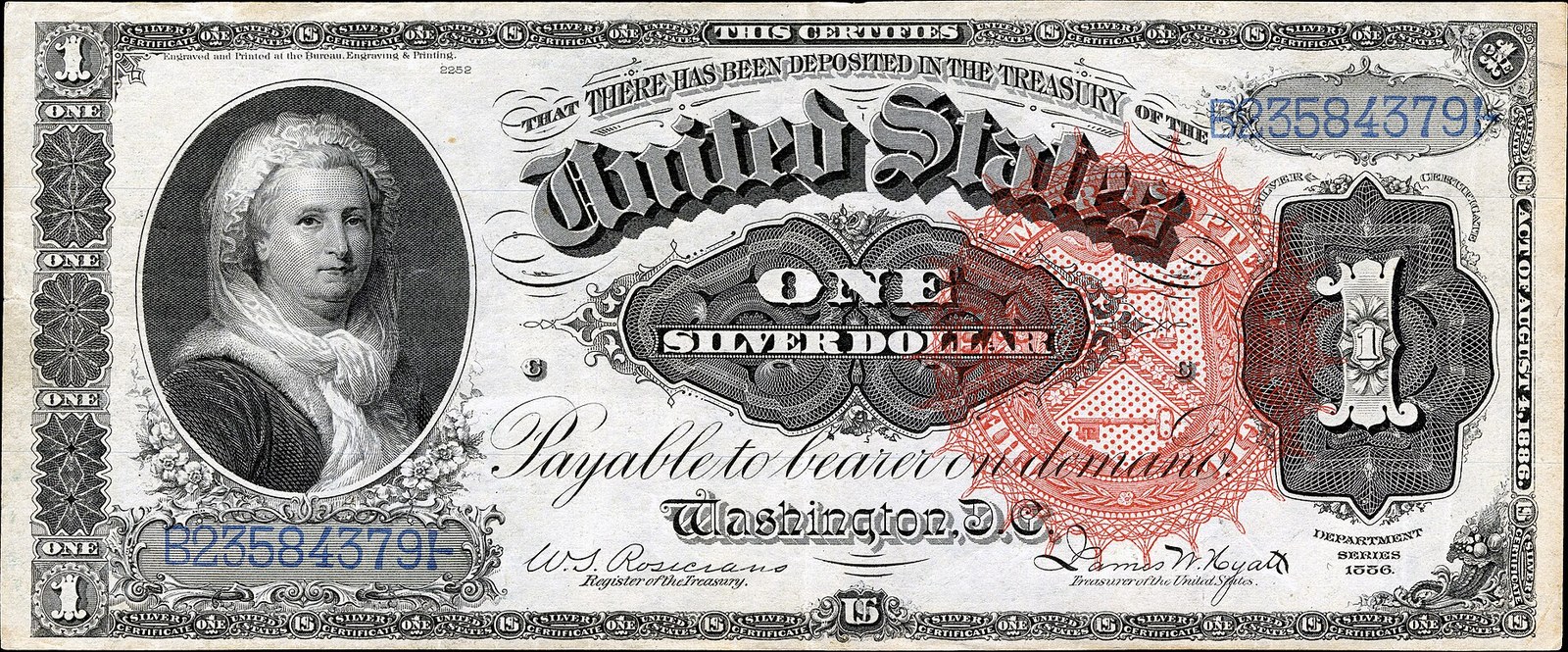
Unlike the famous 1896 Educational Series $1, the 1886 note places Martha Washington on the front.
The Smithsonian's National Museum of American History has an 1886 $1 Silver Certificate showing Martha Washington's portrait prominently on the left side of the note.
The note is large by today's standards, measuring roughly 3⅛ by 7⅜ inches.
That alone makes it immediately recognizable when compared with modern currency.
The note also carried the language identifying it as a Silver Certificate backed by a silver dollar deposited with the Treasury.
At the time, this wasn't simply collectible money.
It was working American currency.
People actually used these notes.
The 1891 Martha Washington Silver Certificate
Martha Washington also appeared on the 1891 $1. Fr. 222 is Rosecrans–Nebeker. Fr. 223 is Tillman–Morgan. They are not the same note as the 1886.
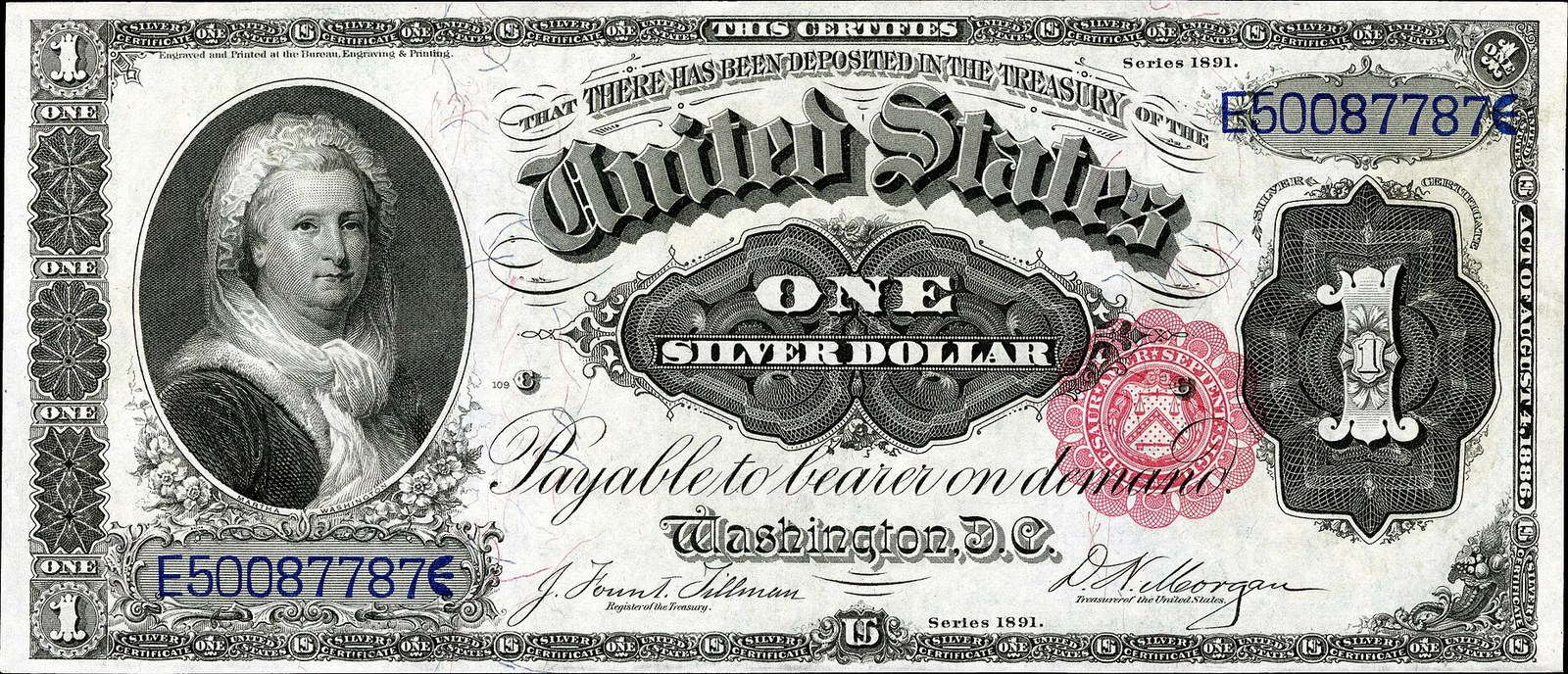
The Smithsonian's example shows Martha Washington's portrait on the left side of the note, with the ornate design continuing around her portrait.
The 1891 note is another large-size Silver Certificate and measures approximately 3⅛ by 7⅜ inches.
For collectors, this means an 1886 Martha Washington note and an 1891 Martha Washington note are not interchangeable.
They are different issues.
The series date is therefore one of the first things to check when someone brings you an old Silver Certificate featuring Martha Washington.
The 1896 Educational Series
Then came one of the most famous designs in American paper-money history.
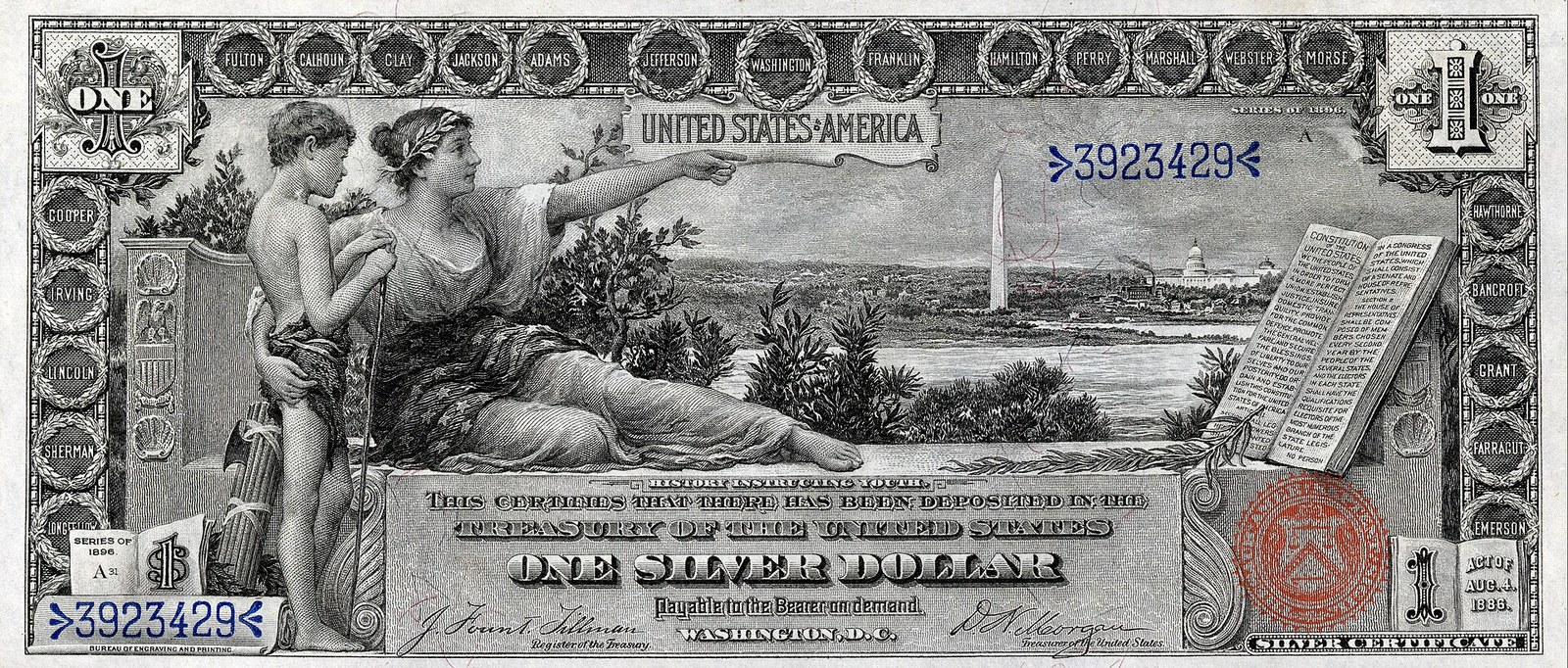
The 1896 series consisted of three regular denominations:
The Smithsonian describes the series as featuring elaborate neoclassical designs and considers the notes among the most beautiful American notes ever printed.
The $1 note is especially famous.
Its front features an allegorical scene called:
“History Instructing Youth.”
And when you turn the note over, there she is:
Martha Washington.
Martha Washington on the 1896 $1 Silver Certificate
The 1896 $1 (Fr. 224) is one of the easiest Martha Washington notes to recognize. Fr. 225 is the Bruce–Roberts signature pair of the same design.
The front features History instructing Youth, with the U.S. Capitol and Washington Monument appearing in the background.
Turn it over and you'll find portraits of:
Martha Washington and George Washington.
The Smithsonian's National Museum of American History specifically identifies Martha Washington on the left and George Washington on the right of the reverse.
This combination is what makes the 1896 $1 so recognizable.
The front tells a story about American history and education.
The back places the country's most famous presidential couple together.
Why Was Martha Washington Chosen?
There is no single simple explanation that completely answers why Martha Washington was selected.
But the choice fits the visual language of the era.
The Educational Series was filled with allegorical figures representing concepts such as History, Science, Commerce, Manufacture, and Electricity.
The designs weren't intended to look like modern currency.
They were intended to communicate ideas.
Martha Washington represented an important part of the nation's founding-era history and provided a recognizable counterpart to George Washington.
The result was unusual:
A woman who wasn't a president, Treasury official, or political officeholder appeared prominently on American paper money.
Martha Washington Wasn't on Just One Note
This is where many casual collectors get confused.
There are several different Martha Washington Silver Certificates.
1886 $1, Fr. 215
Martha Washington appears on the front.
1891 $1, Fr. 222
Martha Washington appears on the front.
1896 $1, Fr. 224
Martha Washington appears on the back, alongside George Washington.
The U.S. Currency Education Program specifically notes that $1 Silver Certificates featured Martha Washington in the 1886 and 1896 series, while Smithsonian collection records document the 1891 issue as well.
So if you find a Martha Washington note, the first question isn't:
“Is this the Martha Washington dollar?”
It's:
“Which Martha Washington dollar is this?”
How to Identify a Martha Washington Silver Certificate
If you have an old note featuring Martha Washington, start with the basics.
Step 1: Find the denomination
Martha Washington appears on $1 Silver Certificates.
If you're looking at a different denomination, you are probably dealing with another type of note or another historical figure.
Step 2: Look for the series
Find the series date.
Look for:
1886
1891
1896
Step 3: Check where Martha appears
If she's on the front, you may have an 1886 or 1891 issue.
If she's on the back beside George Washington, you may have the famous 1896 Educational Series $1.
Step 4: Photograph both sides
A photograph makes identification much easier.
Take a clear photo of the entire note, then close-ups of:
- Series date
- Serial number
- Treasury seal
- Signatures
- Any unusual markings
- Damage
What Does a Martha Washington Silver Certificate Look Like?
The easiest way to understand the different notes is to compare them.
| Series | Martha Washington Location | Major Design |
|---|---|---|
| 1886 | Front | Portrait of Martha Washington |
| 1891 | Front | Portrait of Martha Washington |
| 1896 | Back | Martha and George Washington |
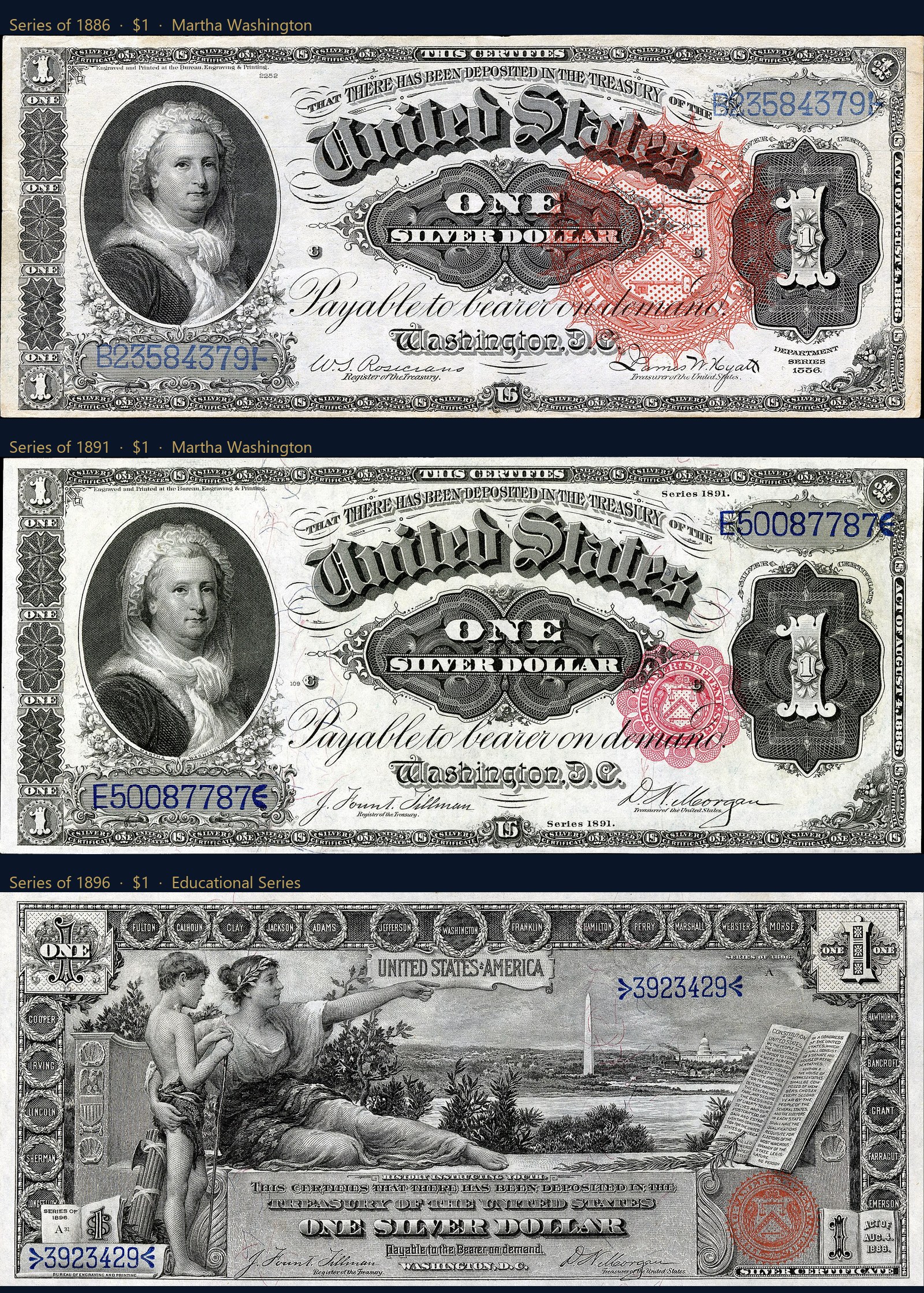
Series of 1886 and 1891 Martha Washington $1 notes with the 1896 Educational Series $1.
The 1896 note is particularly easy to identify because of the elaborate History Instructing Youth design on the front.
The 1886 and 1891 notes have Martha prominently displayed on the front.
Why Is the 1896 Note Called the Educational Series?
The nickname comes from the educational themes incorporated into the designs.
The $1 features History instructing Youth.
The $2 features Science presenting Steam and Electricity to Commerce and Manufacture.
The $5 features Electricity as a powerful allegorical figure.
The idea was to use the nation's currency to communicate American history, knowledge, technology, and progress.
The $1 is therefore more than a note featuring Martha Washington.
It's part of one of the most ambitious artistic experiments in American currency.
Was Martha Washington the Only Woman on U.S. Currency?
This requires a little clarification.
Martha Washington is famous for being the only historic woman whose portrait appeared on U.S. paper currency in this particular traditional portrait role for many years.
The Smithsonian notes that Martha Washington was the only historic woman to appear with her portrait on U.S. paper currency, specifically on the face of the $1 Silver Certificate in the 1886 and 1891 series and on the back of the $1 Silver Certificate in 1896.
That makes these notes especially interesting to collectors interested in the history of women on American money.
There have been other women represented on U.S. currency and other forms of American money, but Martha Washington's position is unique in the history of U.S. paper currency.
Is a Martha Washington Silver Certificate Rare?
This is where collectors need to be careful.
Martha Washington appearing on a note does not automatically tell you its value.
The exact series matters.
Condition matters.
Varieties matter.
Serial numbers matter.
And the market matters.
An 1886 note and an 1896 note are different collectibles.
A heavily circulated example and an exceptionally preserved example are different collectibles.
A note with an unusual variety or other desirable characteristic may be considerably more valuable than an ordinary example.
So don't stop at:
“It has Martha Washington, so it must be worth a lot.”
Instead ask:
Which note is it?
How scarce is this particular note?
What condition is it in?
What have comparable examples actually sold for?
How Much Is a Martha Washington Silver Certificate Worth?
There isn't one universal answer.
The value can vary substantially depending on the exact issue and condition.
A Martha Washington Silver Certificate can be worth significantly more than its original face value, but the price of a particular example needs to be determined from the actual note.
For example, a collector researching an 1896 $1 should not compare it with a random 1886 $1 or with a generic “Martha Washington dollar” listing.
The best comparison is another note with the same:
- Series
- Denomination
- Variety
- Signature combination
- Serial-number characteristics
- Condition
- Certification
And ideally, you're looking at completed sales, not asking prices.
Why Condition Matters So Much
Imagine two 1896 Educational Series $1 Silver Certificates.
Both are genuine.
Both have Martha Washington on the back.
Both are from the same series.
But one has:
- Multiple folds
- Rounded corners
- Tears
- Stains
- Writing
The other is:
- Crisp
- Bright
- Sharp-cornered
- Free from major damage
- Professionally graded
They may be the same basic note, but collectors can value them very differently.
This is one of the most important concepts in paper-money collecting:
The grade can be almost as important as the identity.
Don't Clean a Martha Washington Note
If you've found one, leave it alone.
Don't:
- Wash it
- Iron it
- Tape it
- Glue it
- Trim it
- Laminate it
- Write on it
Old paper money is collectible partly because of its originality.
An attempt to make a note “look better” can actually make it less desirable.
If you aren't sure what you have, preserve it exactly as you found it.
What About the Serial Number?
The serial number is another detail worth recording.
Look for:
- Low numbers
- Repeating numbers
- Sequential numbers
- Radar numbers
- Other unusual patterns
- Star symbols
A star can indicate a replacement note.
But remember:
A star doesn't automatically make a note rare.
The specific issue and scarcity of that replacement variety matter.
Likewise, an attractive serial number may add collector interest without transforming a common note into a major rarity.
Martha Washington and the History of American Women on Money
The significance of these notes goes beyond numismatics.
Martha Washington's appearance on U.S. currency is a window into how Americans thought about national identity during the late 19th century.
Her portrait connected the currency to the country's founding generation.
At the same time, the elaborate designs of the Educational Series used allegorical female figures to represent abstract ideas such as History, Science, and Electricity.
There is something fascinating about the contrast.
The woman on the back is a real historical person.
The woman on the front is an allegorical representation.
Together, they show two very different ways women were represented in American visual culture.
Martha Washington and George Washington Together
The 1896 $1 is especially interesting because the reverse places Martha and George Washington together.
George Washington's appearance on American currency is hardly surprising.
Martha's is.
The pairing creates an interesting visual connection between America's first presidential family and the broader historical message of the Educational Series.
It also makes the 1896 $1 instantly recognizable to collectors.
The 1886 Note Is Especially Important
The 1886 $1 Silver Certificate deserves special attention because it represents the beginning of Martha Washington's appearance on U.S. paper currency.
The Smithsonian's collection includes an 1886 $1 Silver Certificate with Martha Washington's portrait on the front.
Congress had authorized $1, $2, and $5 Silver Certificates in 1886, making these lower-denomination certificates much more practical for everyday use.
Martha's portrait therefore wasn't appearing on an obscure commemorative object.
It appeared on actual circulating American currency.
People used these notes to conduct ordinary business.
The 1891 Note Is Easy to Overlook
Collectors sometimes focus so heavily on the famous 1886 and 1896 issues that the 1891 Martha Washington note gets overlooked.
But the Smithsonian has a Series 1891 $1 Silver Certificate with Martha Washington prominently displayed on the front.
If you're building a collection around Martha Washington on U.S. currency, the 1891 issue belongs on your radar.
This is another reason that identifying the series date is so important.
Why the 1896 Educational Series Gets So Much Attention
The 1896 series has everything collectors tend to love:
History.
Art.
Famous people.
Symbolism.
Engraving.
A distinctive design.
And Martha Washington.
The Smithsonian describes the series as among the most beautiful American notes ever printed.
The Bureau of Engraving and Printing similarly identifies the 1896 notes as part of the Educational Series and highlights their elaborate designs.
For many collectors, the 1896 $1 isn't just something to own.
It's something to study.
How to Tell Which Martha Washington Note You Have
Here's the quick version.
If Martha Washington is on the FRONT:
Look for the series.
1886 → 1886 $1 Silver Certificate
1891 → 1891 $1 Silver Certificate
If Martha Washington is on the BACK beside George Washington:
1896 → 1896 Educational Series $1 Silver Certificate
Once you've narrowed it down, then you can start researching its specific market.
Don't Rely on a Generic “Martha Washington Dollar” Price
Search engines and online marketplaces can make this confusing.
You may find listings titled:
- “Martha Washington Dollar”
- “Rare Martha Washington Bill”
- “1886 Martha Washington Silver Certificate”
- “1896 Martha Washington Note”
- “Old Martha Washington Money”
These titles aren't necessarily standardized.
Some sellers may use broad descriptions designed to attract attention.
Some may be asking far more than the note's actual market value.
And some may be describing a completely different issue.
This is why the exact note should always come first.
Asking Price vs. Actual Sale
If you're trying to determine what your Martha Washington Silver Certificate is worth, don't simply search for the highest price you can find.
Look for actual completed sales.
A seller asking $2,000 doesn't mean the note is worth $2,000.
A seller asking $200 doesn't necessarily mean it's worth only $200.
The better evidence comes from comparable examples that actually sold.
And the comparison needs to be close.
Same note.
Same variety.
Similar condition.
Similar certification.
Similar characteristics.
That's how you begin to understand the actual market.
On Rarity Ledger you get there by confirming a catalog match — search or a photo — and then reading the auction lots joined to that ID. An 1886 $1 (Fr. 215) is not priced from an 1896 $1 (Fr. 224). Buy It Now prices on auction sites, including eBay, are included. Retail and dealer shop prices are not.
What to Photograph
If you have a Martha Washington Silver Certificate, take clear photographs of:
The entire front
The entire back
Series date
Serial number
Martha Washington portrait
Any unusual features
Good photographs can make identification dramatically easier.
And if the note turns out to be something special, you'll have a record of it before handling it further.
Is Your Martha Washington Note Worth More Than $1?
It might be.
But don't start with the assumption that it is extremely valuable.
Start with identification.
There are multiple Martha Washington Silver Certificates.
The 1886, 1891, and 1896 issues are different notes.
Condition can make a major difference.
Varieties can matter.
Serial numbers can matter.
Star notes can matter.
And the actual sales history matters most when you're trying to understand market value.
The Smithsonian, U.S. Currency Education Program, and Bureau of Engraving and Printing all document Martha Washington's unusual place in American currency history.
The Bottom Line
Martha Washington's appearance on U.S. currency is one of the most fascinating stories in American paper-money history.
She appeared on:
1886 $1, Fr. 215 — front
1891 $1, Fr. 222 — front
1896 $1, Fr. 224 — back, alongside George Washington
The 1896 example is part of the famous Educational Series, whose elaborate designs remain among the most recognizable creations in American currency.
If you've found one, don't assume the answer is simply:
“It's a Martha Washington bill.”
Find out exactly which one you have.
Check the series.
Check the condition.
Check the serial number.
Look for varieties.
Then look at what comparable examples have actually sold for.
Because the most useful question isn't:
“Is Martha Washington on this bill?”
It's:
“Exactly what is this note—and what have copies of it sold for?”
Image credits
U.S. currency images are public-domain works of the United States government (Bureau of Engraving and Printing), reproduced from Wikimedia Commons and the National Numismatic Collection at the Smithsonian Institution. Product screenshots are original to Rarity Ledger.