
How Much Is a $2 Bill Worth?
Most $2 bills are still two dollars. Red seals, series letters, stars, and large-size notes are different items. Identify the note before you price it.
A $2 bill looks unusual enough that people assume it must be rare.
Usually it isn't.
The United States still prints the denomination. Banks still order it. A green-seal Jefferson from 1976 or later is legal tender, still spends as two dollars, and often carries only a small premium as a curiosity.
A red-seal $2 is a different note. A star next to the serial number is a different note again. A large-size $2 from before 1928 is another family entirely.
The question is simple: is the bill in your hand worth more than two dollars? The answer is identity first, then comparable sales. Not the highest asking price on a listing.
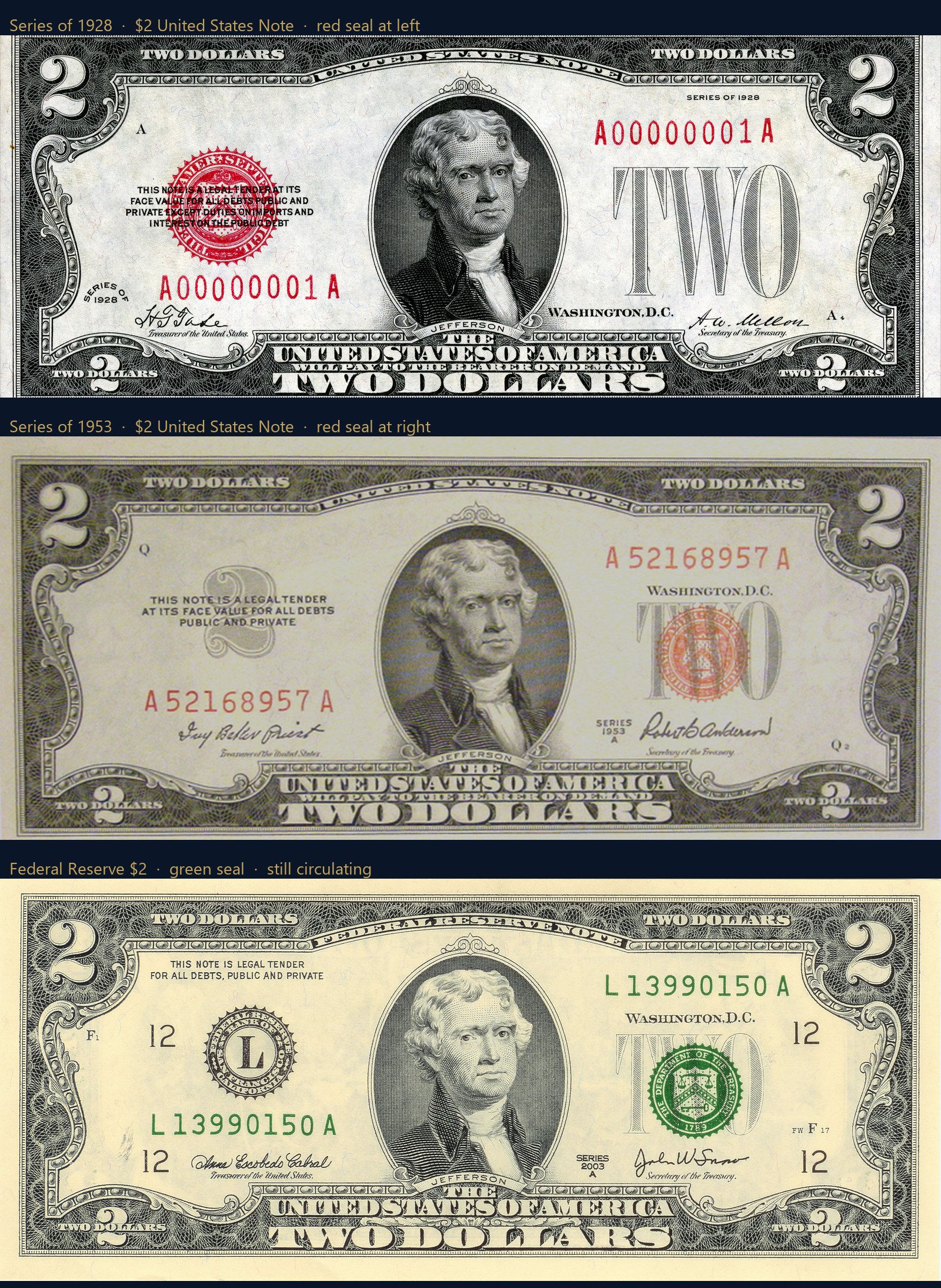
Three small-size $2 faces: red seal at left (1928), red seal at right (1953), and a circulating green-seal Federal Reserve Note. Public domain, Bureau of Engraving and Printing / National Numismatic Collection.
The short answer
Most $2 bills people find in a drawer are common.
If the Treasury seal and serial numbers are green, you almost certainly have a Federal Reserve Note from Series 1976 or later. Those notes are still current. Circulated examples typically sit at face value, or a little over face if someone wants a crisp souvenir.
If the seal and serials are red, you have a United States Note — a Legal Tender issue from Series 1928, 1953, or 1963. Those are collectible. Many circulated red seals still sell for a modest premium, not a fortune. Stars, early 1928 sub-series, and high-grade notes are where the tape widens.
If the note is larger than a modern bill, you are not looking at the Jefferson $2 most people mean. Large-size Legal Tender and Federal Reserve Bank Notes are separate catalog rows.
Do not invent a price from the year printed on the face. Read the seal, the series, the serial, and the size.
First: which $2 do you have?
Look at four things before you search a price.
1. Size. A modern small-size note is about 6.14 × 2.61 inches. A large-size note from 1917 or 1918 is noticeably bigger. If it looks oversized next to a modern bill, treat it as large-size.
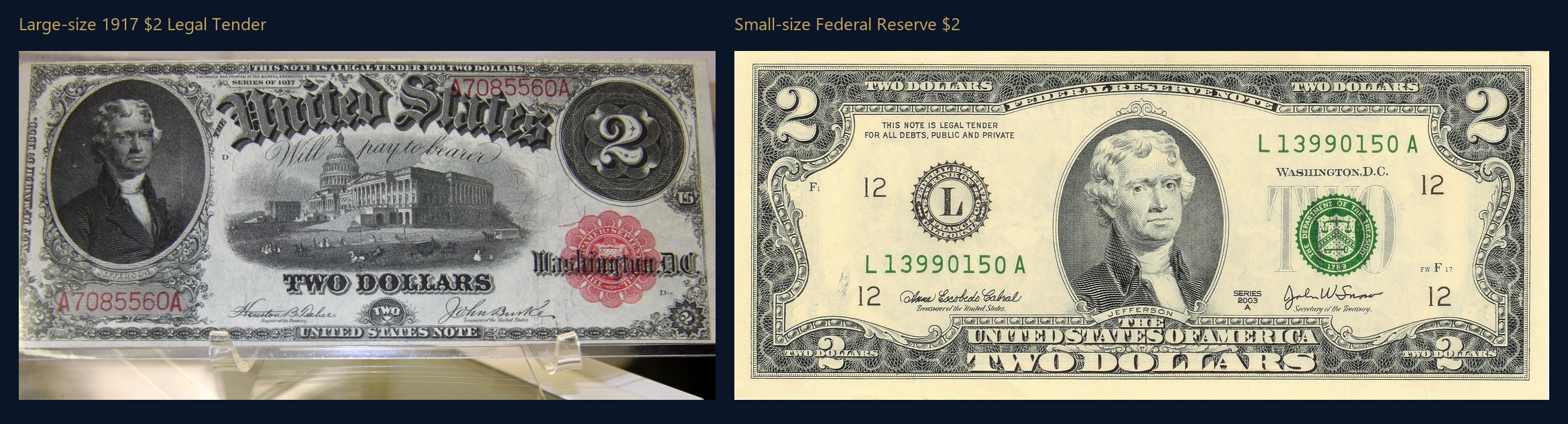
Large-size 1917 $2 Legal Tender (Fr. 60) beside a circulating small-size Federal Reserve $2. Same denomination. Different catalog items.
2. Seal color. On a small-size $2, red means United States Note and green means Federal Reserve Note. That split is the fastest filter in this article. A large-size 1918 with a district seal is a third family.
3. Series. The series is printed on the face — Series of 1928, Series 1953, Series 1963A, Series 1976, and later letters. A 1928 and a 1928B are not the same Friedberg number.
4. Serial number. A star at the beginning or end marks a replacement note. Fancy serials (low numbers, radars, repeaters) can add a premium on any type. The Smithsonian example of the 1928 $2, Fr. 1501 is serial A00000001A. That is not what a typical circulated 1928 looks like.
If you only remember one rule: the red-seal $2 and the green-seal $2 are not priced off each other.
Green seal: the $2 still in circulation
Series 1976 brought the $2 back as a Federal Reserve Note. The face still shows Jefferson. The back switched from Monticello to John Trumbull's Declaration of Independence. The seal and serials are green.
Later series — 1995, 2003, 2003A, 2009, 2013, 2017, and so on — keep that design family. A 2017 $2 is still a $2. Age on a green seal does not create rarity by itself.
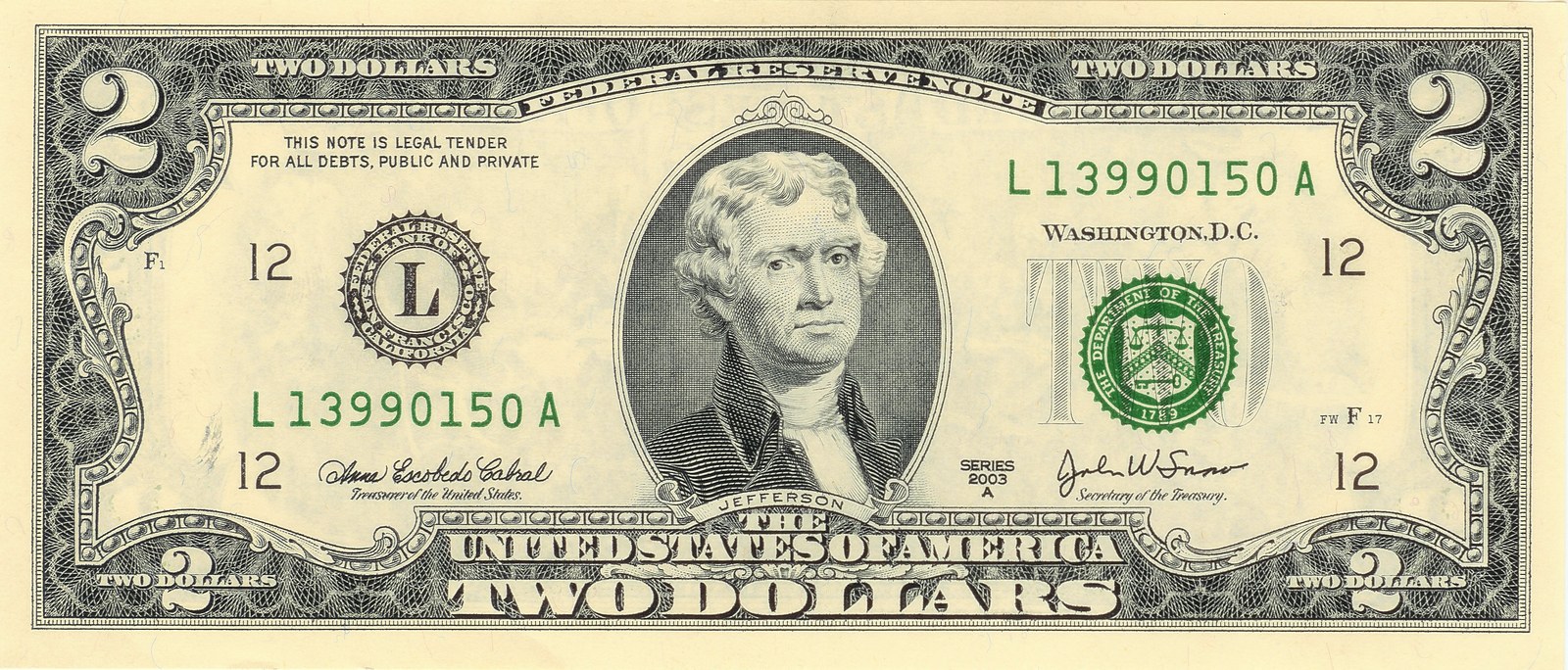
Green Treasury seal and serials: Federal Reserve $2, still current. This example is a later series of the same design family that began in 1976.
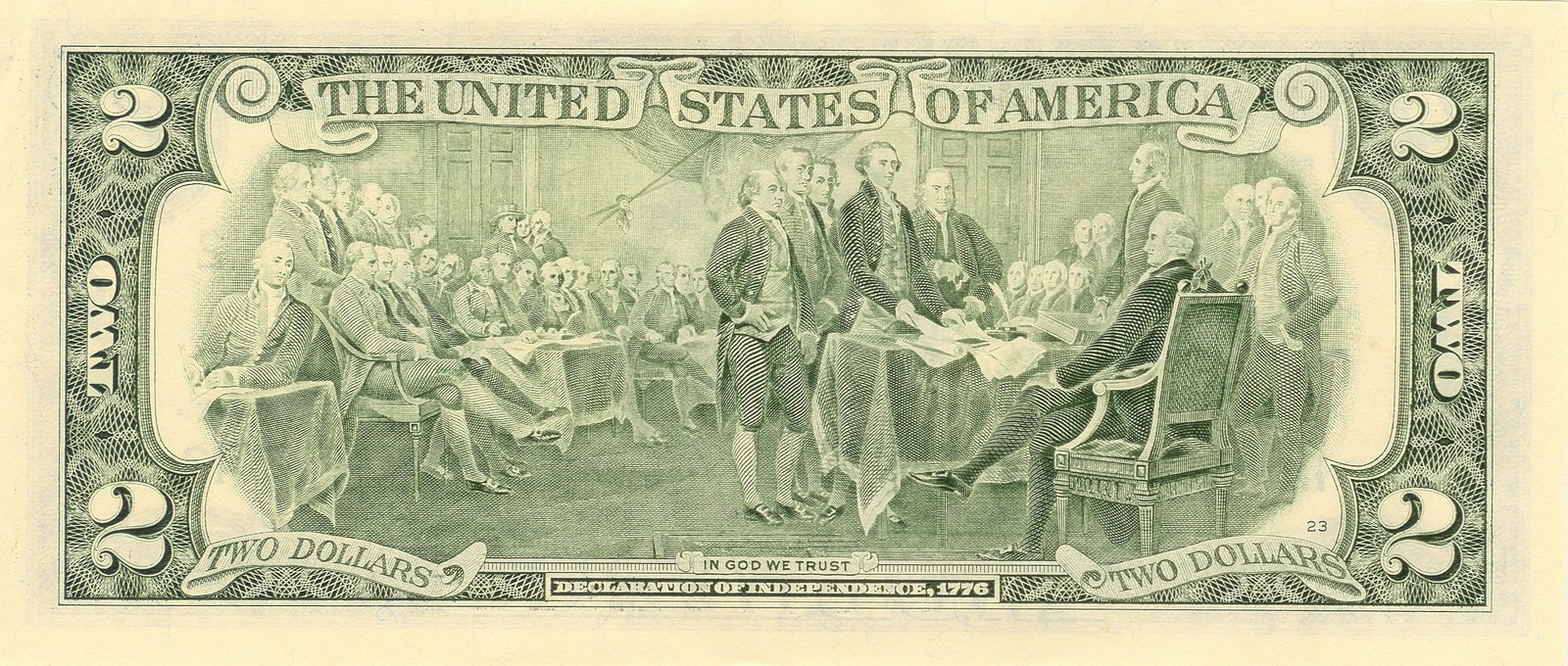
The back used since Series 1976. Monticello is the red-seal back, not this one.
What people usually hold:
- A circulated Series 1976 or later note from a bank, a birthday card, or a cash register. Face value.
- A crisp uncirculated example someone saved. A small souvenir premium, not a rare-note premium.
- A star note. Replacement $2 FRNs exist. Some districts and series are common; a few are scarcer. The star is the tell — then you still need the series and district.
- A first-day cancel. In April 1976 some people had Series 1976 notes stamped at a post office. Collectors buy those as a souvenir type. The stamp does not turn a common FRN into a 1928 red seal.
- An uncut sheet. BEP sheets are a product, not a circulation find. Price them as sheets, not as a stack of single notes.
District letters on a 1976 $2 are separate catalog numbers. Fr. 1935-A is one district. A Boston note is not a Dallas note. If you are matching sales, match the Friedberg row.
Red seal: United States Notes, 1928–1963
Red-seal $2 bills are United States Notes, also called Legal Tender Notes. They are not Silver Certificates. They are not Federal Reserve Notes. The obligation language and the red ink are the tell.
Small-size red-seal $2s come in three series groups:
| Series | Seal position | Friedberg examples | What you are usually looking at |
|---|---|---|---|
| 1928, 1928A–G | Left of Jefferson | Fr. 1501 through Fr. 1508 | Earlier small-size type; sub-series matter |
| 1953, 1953A–C | Right, over TWO | Fr. 1509 and later 1953 letters | The red seal people find most often |
| 1963, 1963A | Right | Fr. 1513, Fr. 1514 | Last red-seal $2s; motto on the back |
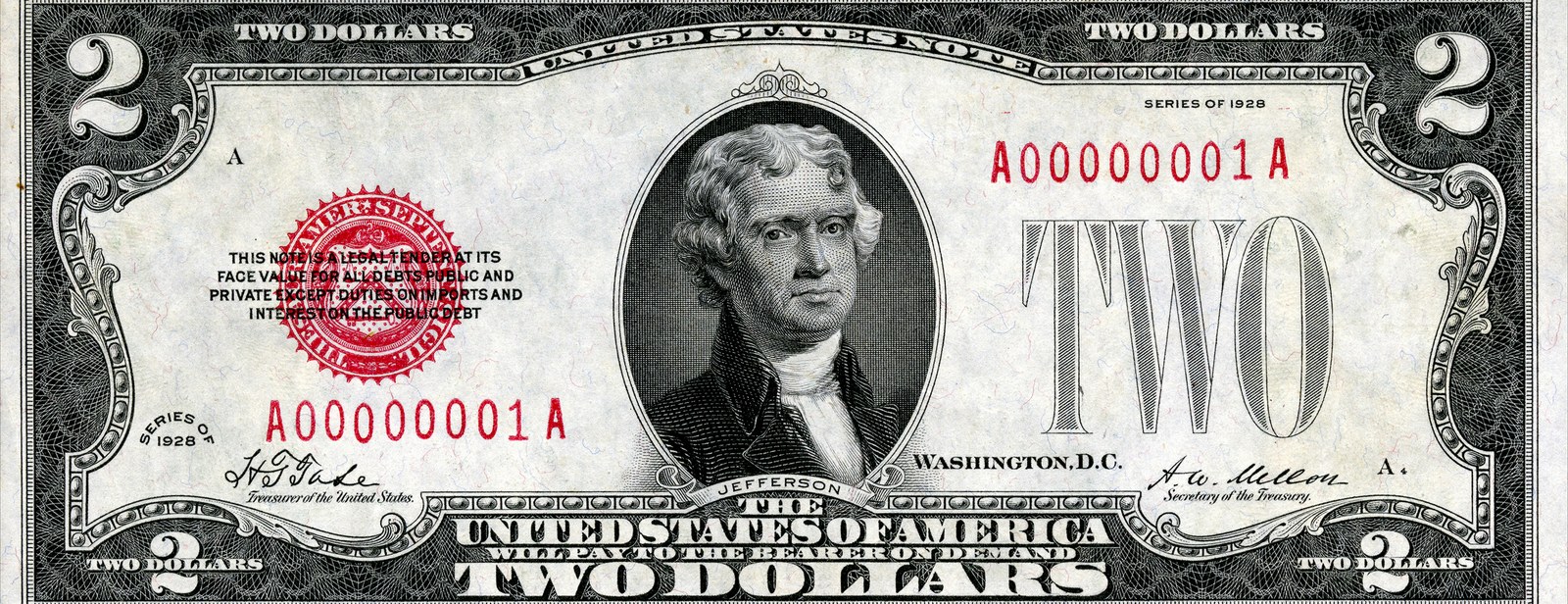
Series of 1928 $2, Fr. 1501. Red seal on the left. National Numismatic Collection example, serial 1 of the printing — not a typical circulated note.
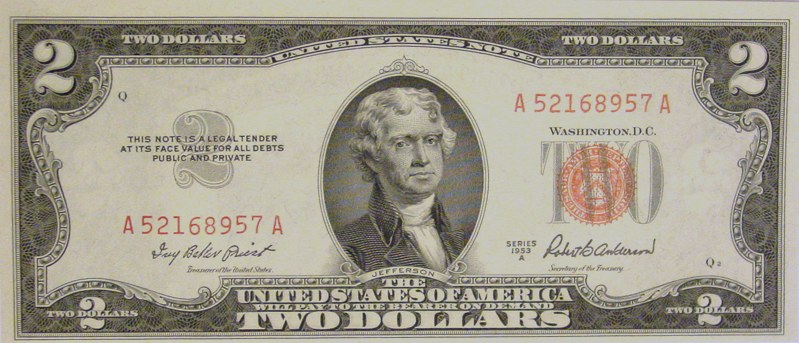
Series 1953 $2. The red seal has moved to the right, over the word TWO.
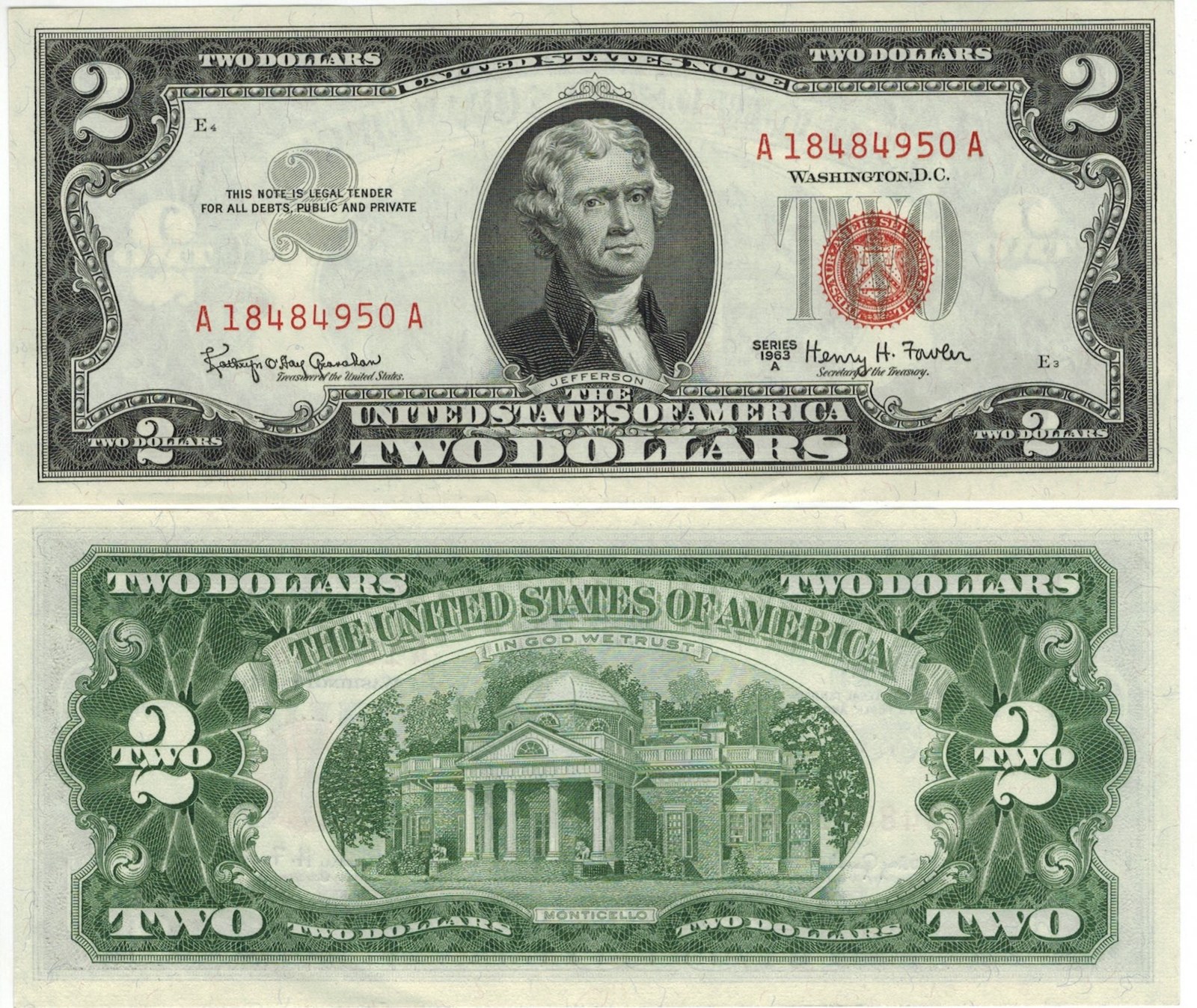
Series 1963A $2, face and back. Monticello remains. “IN GOD WE TRUST” is on this series; it is not on 1953.
A circulated 1953 or 1963 red seal is collectible and usually inexpensive. A circulated 1928 typically sits above a 1953 of the same grade, because the type is earlier and some sub-series are scarcer. None of that is a price. It is a sorting rule.
The 1928 sub-series are not one note
Series 1928 $2s run 1928 through 1928G. Signature combinations change the Friedberg number.
- Fr. 1501 — Series 1928
- Fr. 1502 — Series 1928A
- Fr. 1503 — Series 1928B
- Fr. 1508 — Series 1928G, among the later and more available faces
1928B is the sub-series collectors watch. The regular note is already less common than a 1928G. The 1928B star — Fr. 1503* — is the famous key in this family. If the series line says 1928B and there is a star in the serial, stop treating it like an ordinary drawer $2.
Mules exist on some 1928C and 1928D notes. Those are plate-number varieties. You will not see “mule” printed on the face. If a listing uses the word, you still need the plate evidence and a catalog match.
1953 and 1963: common, not worthless
These are the red seals that turn up in envelopes and old wallets.
They are not rare as a type. They are worth more than face in typical collector grades, and more still if the paper is fully original and uncirculated, or if the serial is a star or a fancy number.
1963 and 1963A are the last red-seal $2s, and the first small-size $2s with the motto on the back. That is a type distinction, not an automatic premium.
Stars for 1953 and 1963 exist as their own rows: Fr. 1509*, Fr. 1513*, Fr. 1514*, and the other series letters. A star is a different note. It is not automatically a 1928B star.
Large-size $2 bills
If the note is the old, larger format, you have left the drawer question and entered type collecting.
The 1917 $2 Legal Tender, Fr. 60 is the large-size Jefferson most people mean. Earlier Legal Tender $2s go back through the nineteenth century — different portraits, different backs, different Friedberg numbers.
There is also a large-size Federal Reserve Bank Note $2 from 1918, with a battleship on the back. That is not a United States Note and not a 1976 FRN. It is a third family.
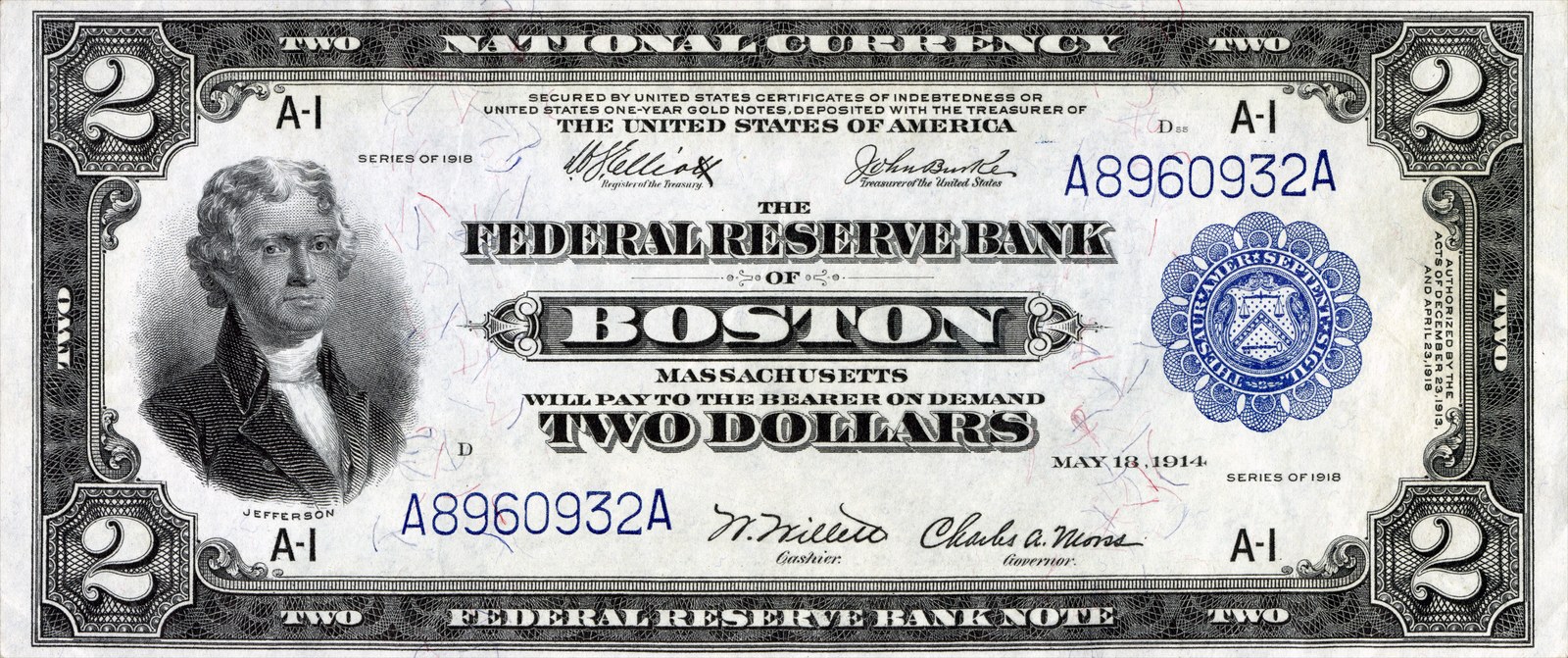
1918 $2 Federal Reserve Bank Note. Jefferson again — a different class of currency.
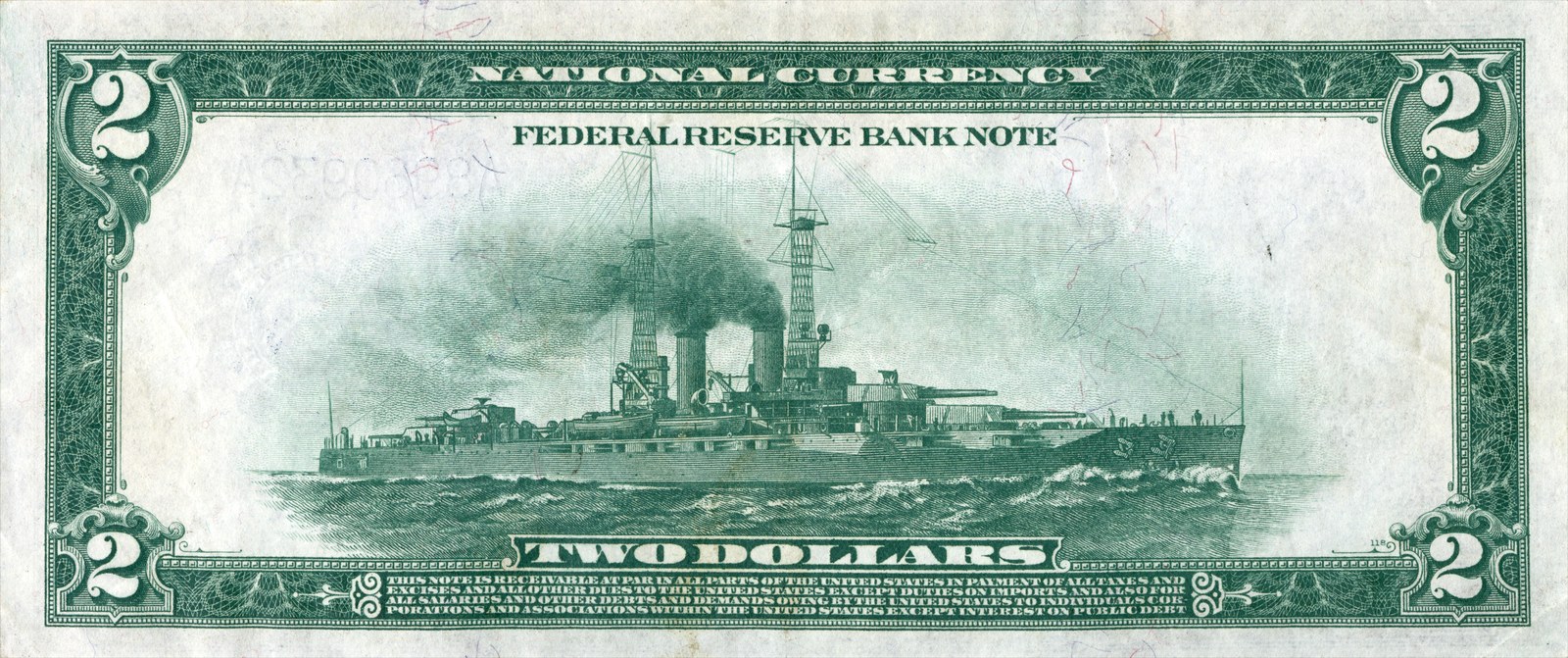
The battleship reverse. If you have this back, you do not have a red-seal Monticello note.
Large-size notes are priced as type, grade, and variety. A worn Fr. 60 and a gem Fr. 60 are not neighbors on the tape.
What actually moves the price
After you know the type, these are the hammers that matter.
Star notes. Replacement serials. Common on some 1953/1963 and 1976+ issues; keys on some 1928 sub-series. Match the star row, not the plain row.
Condition. Folds, soil, rounded corners, and writing crush a gem premium. Most red seals that spent time in a wallet are Very Fine or worse. A “looks new” note can still be a 58, not a 66.
Fancy serials. Low numbers, ladders, radars, repeaters. These stack on top of type. They do not replace type. A fancy serial on a 2017 FRN is still a 2017 FRN.
Errors. Offsets, misalignments, inverted backs, ink errors. Photograph the error. Then find sales of that error on that type. A listing that says “error” is not a diagnosis.
First-day stamps and souvenirs. 1976 cancels are a side market. Price them against other stamped 1976 notes, not against a 1928 red seal.
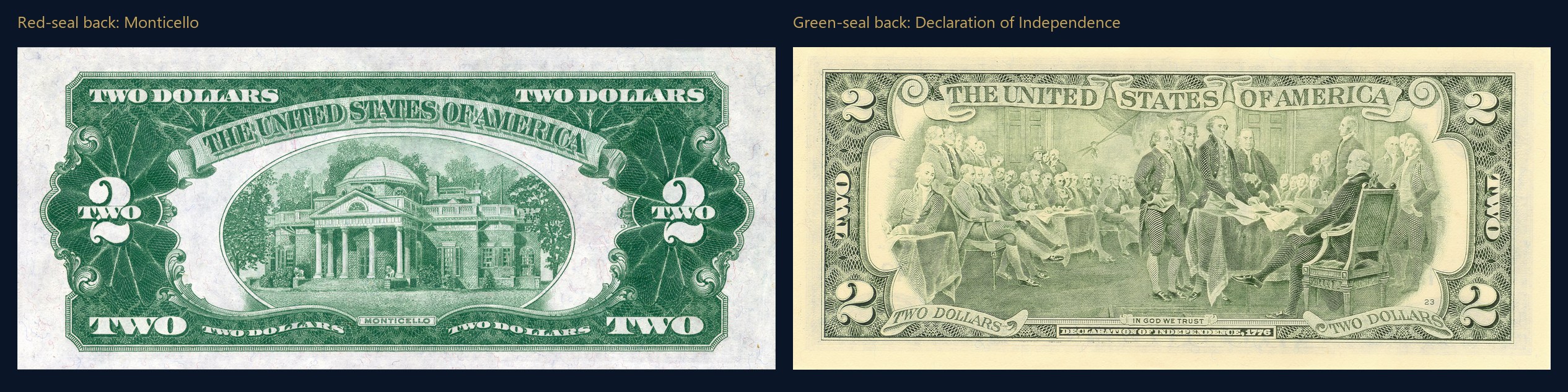
Red-seal back: Monticello. Green-seal back: Declaration of Independence. If you only have a photo of the back, you can already split the two families.
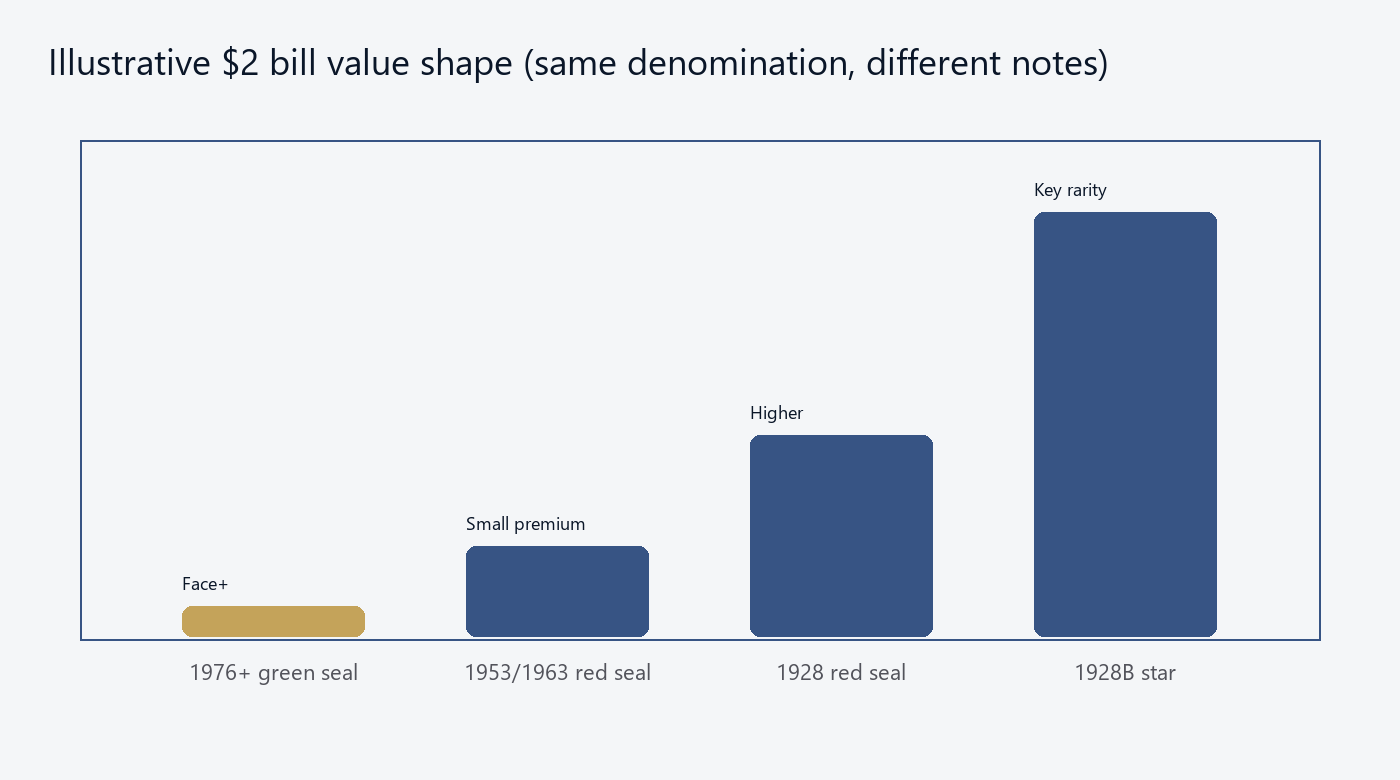
Illustrative shape only — not a quote. A circulating green seal and a 1928B star do not share a price.
What a $2 bill is not
It is not automatically rare because the cashier looked surprised.
It is not a Silver Certificate. Blue-seal $1s are a different article: how to tell if a Silver Certificate is rare.
It is not worth “whatever the eBay listing asks.” Asking prices are not sales.
It is not one number. “$2 bill value” is a search, not a catalog ID.
How to value the note you actually have
- Photograph both sides, flat, in even light. Include the series line and the serial.
- Name the type: large-size or small-size; red seal or green seal.
- Read the series letter. 1928B is not 1928G. 1953A is not 1963A.
- Check for a star and for anything odd in the serial.
- Match a catalog row. Fr. 1501 is the 1928 $2 United States Note. Fr. 1509 is the 1953. Fr. 1935-A is one 1976 district.
- Compare sold lots in a similar grade. Ignore the highest ask.
On Rarity Ledger that order is a catalog match you confirm — search or a photo — and then the auction lots joined to that ID. Buy It Now prices on auction sites, including eBay, stay in the estimate. Retail and dealer shop prices do not. If a grade has no comps, the page leaves them missing.
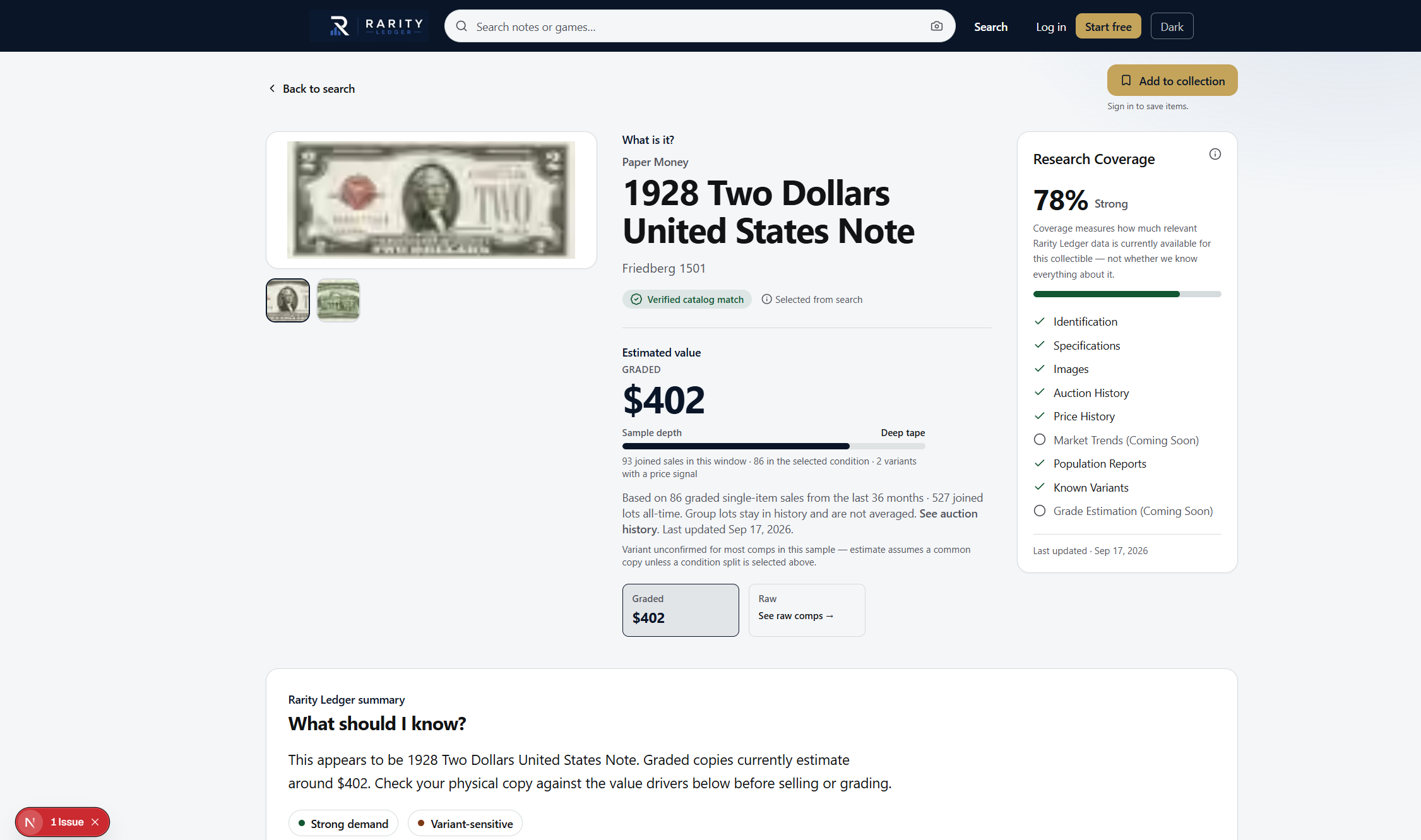
The item page for Fr. 1501: identity, then joined sales. A graded estimate is not a bid for the note in your hand.
Recent joined sales on that 1928 page have included mid-hundreds for certified gems and lower figures for raw or lower-grade notes. Those are examples of the spread, not a quote for every 1928. A 1953 circulated red seal and a 1928B star do not belong on the same line.
A checklist for the bill in your hand
☐ Is it small-size or large-size?
☐ Is the seal red or green?
☐ What does the series line say, including the letter?
☐ Is there a star in the serial?
☐ Is the serial unusual (low, repeating, radar)?
☐ Is the back Monticello or the Declaration?
☐ Are there folds, stains, writing, or pinholes?
☐ If it is 1928, which letter — and is it a 1928B star?
Then look up that note.
If you want the catalog match done from a photo, start on Rarity Ledger. Confirm the row. Read the tape that is joined to it. That is the whole product: identity first, then the hammers.
Image credits
U.S. currency images are public-domain works of the United States government (Bureau of Engraving and Printing), reproduced from Wikimedia Commons and the National Numismatic Collection at the Smithsonian Institution. The 1928 face is NNC serial A00000001A. Charts and product screenshots are original to Rarity Ledger.