
How to Tell if a Silver Certificate Is Rare
Age is not rarity. Series, stars, seals, and comparable sales are. A checklist for the Silver Certificate in your hand.
Finding an old U.S. Silver Certificate can be exciting.
Finding out whether it's rare is another matter.
A blue-seal $1 Silver Certificate from 1957 might be worth only a small amount above face value, while another Silver Certificate from a much earlier series could be worth hundreds or thousands of dollars. And sometimes a detail as small as a star next to the serial number can change the collector value significantly.
The important thing is that age alone doesn't determine rarity.
If you have a Silver Certificate, the goal is to identify exactly what you have, then determine how scarce that particular note is and what comparable examples have actually sold for.
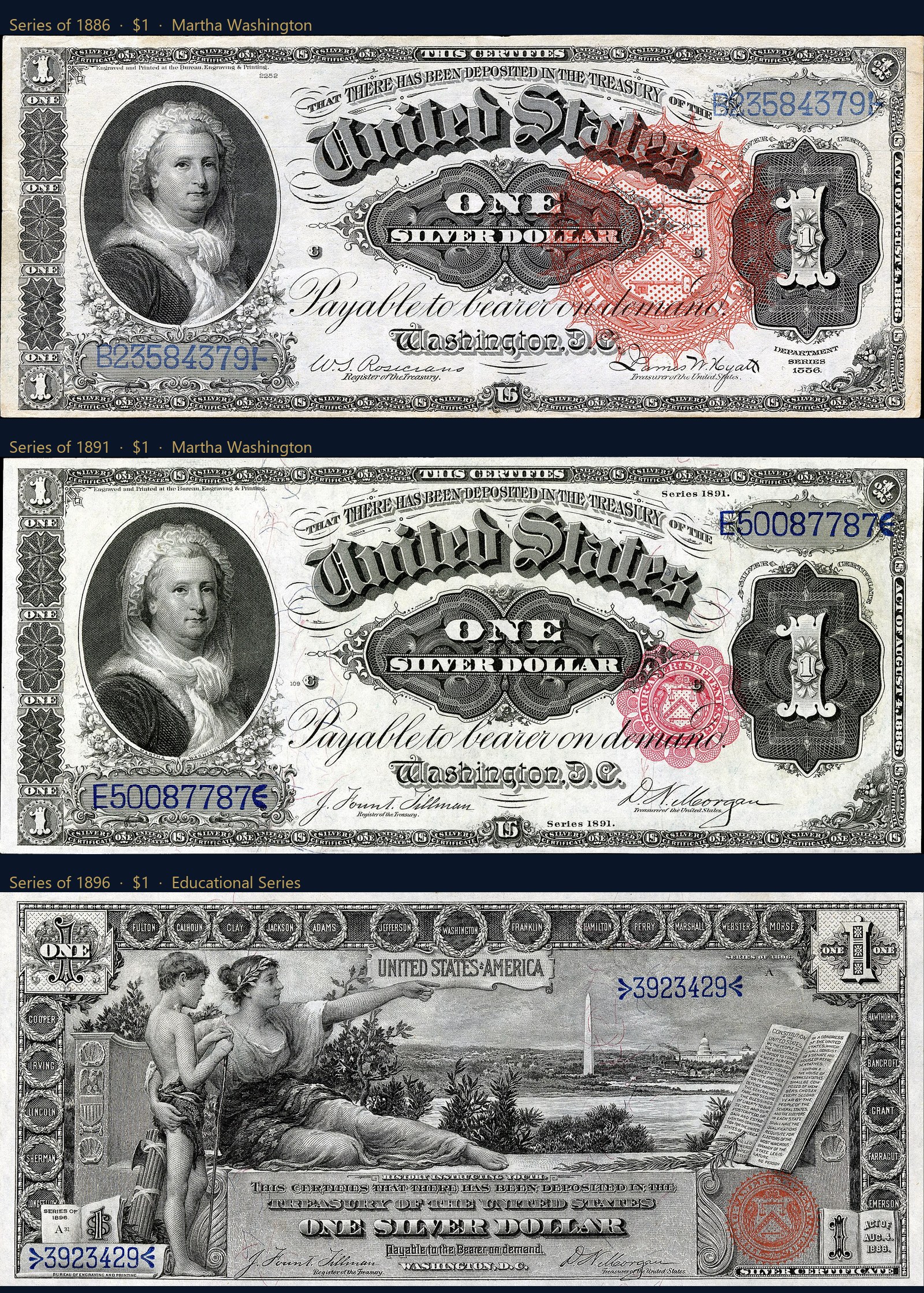
Three $1 Silver Certificate designs from 1886, 1891, and 1896. Public domain, National Numismatic Collection.
What Makes a Silver Certificate Rare?
There isn't one single test for rarity.
Collectors typically look at several characteristics:
- Series and date
- Denomination
- Size and design
- Signature combination
- Serial number
- Star notes
- Printing varieties
- Errors
- Condition
- Survival rate
- Actual sales history
A note can be old without being rare.
A note can also be relatively common in one condition but scarce in another.
And a note that looks almost identical to another can have a completely different market value because of a small identifying detail.
First: Make Sure You Have a Silver Certificate
Before determining whether a note is rare, make sure you have correctly identified it.
Older Silver Certificates generally carry the words “SILVER CERTIFICATE” on the note and, depending on the issue, have distinctive blue seals and serial numbers.
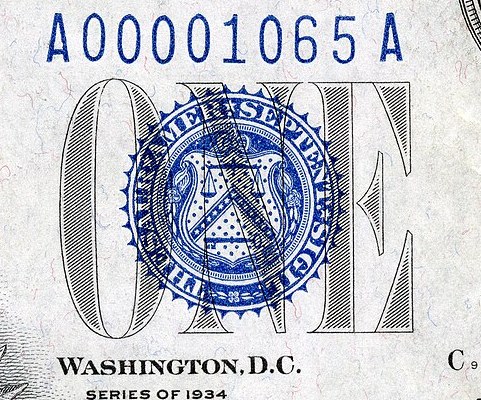
Blue Treasury seal and serials are the quick tell on small-size Silver Certificates.
Silver Certificates were issued for decades, from the late 19th century through the 1960s. The Bureau of Engraving and Printing's historical records document numerous series and denominations across that period.
This means there isn't really one thing called a “Silver Certificate.”
There are many different collectible notes that happen to belong to the Silver Certificate family.
That's why the next question should be:
Which Silver Certificate do I have?
1. Check the Series Date
The series date is one of the most important clues.
Look for wording such as:
- Series 1886
- Series 1896
- Series 1899
- Series 1928
- Series 1934
- Series 1935
- Series 1957
You may also see letters after a date, such as:
- 1935A
- 1935B
- 1935E
- 1957A
- 1957B
Those details matter.
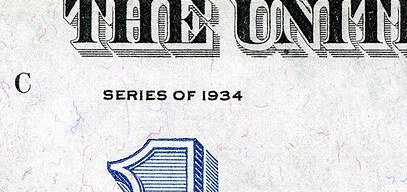
The 1935 and 1957 $1 Silver Certificates, for example, are among the most commonly encountered Silver Certificates. By contrast, much earlier large-size issues can be substantially scarcer.
So if someone tells you:
“I have a 1957 Silver Certificate. Is it rare?”
The answer is probably not—but that's not enough information to stop looking.
There can still be special varieties, star notes, unusual serial numbers, and exceptional-condition examples.
2. Look at the Denomination
Don't overlook the denomination.
Silver Certificates were issued in denominations ranging from relatively small notes to extremely high denominations.
The Bureau of Engraving and Printing records Silver Certificates in denominations including $1, $2, $5, $10, $20, $50, $100, $500, and $1,000 during different periods.
A $1 Silver Certificate found in an old drawer belongs to a very different collecting category from an early high-denomination Silver Certificate.
Higher denominations from the 19th century are particularly unusual today, and early large-size certificates can be highly collectible.
So before searching for a value, record the exact denomination.
3. Is It a Large-Size Silver Certificate?
This is one of the easiest ways to narrow down an old note.
U.S. paper money was significantly larger before 1928.
Collectors generally refer to these earlier notes as large-size currency.
If your Silver Certificate is dramatically larger than a modern bill, don't treat it like a typical 1935 or 1957 $1.
You may be looking at an older and considerably more collectible issue.
Large-size Silver Certificates include famous issues such as:
- 1886
- 1891
- 1896
- 1899
- 1923
The 1896 Educational Series is particularly famous for its elaborate artwork and consists of $1, $2, and $5 notes. The Bureau of Engraving and Printing identifies the 1896 $2 as part of this Educational Series.
Large-size does not automatically mean rare, but it is an important clue that the note deserves closer examination.
4. Check the Serial Number
Now look closely at the serial number.
Don't just write down the numbers.
Look at the entire serial number and pay attention to anything unusual.
A serial number can sometimes tell you something about the note's issue or replacement status.
It can also have collectible characteristics of its own.
Collectors may look for:
- Very low serial numbers
- Repeating numbers
- Solid numbers
- Radar numbers
- Ladders
- Interesting patterns
- Unusual combinations
For example:
00000001
11111111
12345678
12344321
These are examples of serial-number patterns collectors may find interesting.
But here's an important distinction:
An unusual serial number does not automatically make a note rare.
It may make the note more desirable.
Those are not always the same thing.
5. Look for a Star
This is one of the easiest things for a beginner to check.
Look at the serial number.
Do you see a ★ where you would normally expect a letter?
You may have a star note.
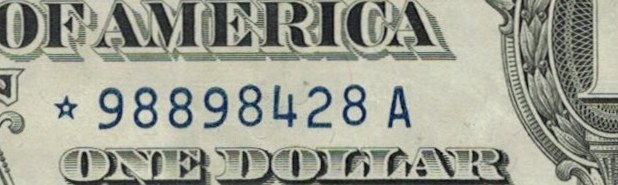
A star at the serial number marks a replacement note. This example is Series 1957.
The Bureau of Engraving and Printing explains that star notes are replacement notes. When a defective sheet is discovered after serial numbers have been applied, the sheet can be replaced with a special replacement sheet rather than attempting to reuse the original serial numbers.
Because replacement notes are produced in smaller quantities than normal notes, star notes are popular with collectors.
But there's another important rule:
Not every star note is rare.
A star can make a common Silver Certificate more collectible without turning it into a four-figure rarity.
The specific series, denomination, star-note print run, condition, and market demand all matter.
6. Check the Condition
Condition may be the single biggest factor separating an ordinary example from a highly desirable one.
Look closely at the paper.
Does the note have:
- Multiple folds?
- A center fold?
- Corner folds?
- Tears?
- Pinholes?
- Stains?
- Writing?
- Missing pieces?
- Rounded corners?
- Edge damage?
- Repairs?
- Bright, original paper?
- Sharp corners?
A Silver Certificate that has spent decades folded inside a wallet is very different from one that was stored flat and protected.
Collectors and grading companies use standardized condition scales, so terms such as Very Fine, Extremely Fine, About Uncirculated, and Uncirculated can become important when researching value.
The difference can be dramatic.
A common note in circulated condition may have little collector premium.
A scarce note in exceptional condition can be worth substantially more.
7. Don't Assume “Uncirculated” Means “Rare”
This is an important distinction.
Rarity and condition are different things.
A 1957 $1 Silver Certificate in pristine condition can be a beautiful collectible without being a rare note.
Millions of examples of some later Silver Certificates were produced.
By contrast, an early large-size note can be genuinely scarce even when it has significant circulation wear.
Think of it this way:
Rare + worn = potentially valuable
Common + pristine = potentially collectible
Rare + pristine = where things can get really interesting
8. Look for Errors
Another reason to slow down before dismissing a Silver Certificate is the possibility of a printing error.
Currency is produced through a complicated manufacturing process.
Errors can occur.
Potentially collectible errors can involve things such as:
- Misaligned printing
- Missing elements
- Incorrect overprints
- Cutting errors
- Ink problems
- Serial-number problems
- Other production abnormalities
But be careful.
A note that looks “wrong” isn't automatically an error.
It could be:
- Damage
- Alteration
- Staining
- Fading
- Someone's attempt to repair the note
- Normal variation
That's why suspected errors are worth having independently evaluated before assuming they are valuable.
And whatever you do, don't attempt to fix the error yourself.
Don't trim it.
Don't clean it.
Don't press it.
Don't tape it.
If the unusual feature is legitimate, altering the note could reduce its value.
9. Look at the Signatures
Older U.S. currency can contain another layer of identification that many casual collectors overlook:
Treasury signatures.
Look closely at the names and signatures on your note.
Different signature combinations can distinguish varieties within a series.
This becomes particularly important with older currency, where two notes with the same denomination and series date may not be exactly the same collectible.
So when documenting a note, don't just record:
1935 $1 Silver Certificate
Record everything you can identify.
For example:
Series 1935
$1
Serial number ______
Star or regular
Signature combination ______
Condition ______
That gives you a much better starting point for research.
10. Learn the Difference Between Rare and Valuable
This distinction causes a lot of confusion.
A note can be rare without being extremely valuable.
A note can also be valuable without being extraordinarily rare.
Why?
Because value depends on more than scarcity.
Collectors also care about:
- Demand
- Condition
- Historical importance
- Design
- Popularity
- Certification
- Provenance
- Eye appeal
- Recent sales
A particularly attractive example of a popular note can command strong prices even if other examples exist.
Meanwhile, an extremely scarce note in poor condition may appeal to a much smaller group of buyers.
So don't stop your research after asking:
“How many exist?”
Also ask:
“What are collectors actually paying for them?”
11. Some Silver Certificates Are Common
This is probably the most important reality check for someone who finds one.
Not every old Silver Certificate is rare.
The 1935 and 1957 $1 Silver Certificates are especially common among the notes people encounter today.
That doesn't mean they're worthless.
It means you should not assume that age alone makes them rare.
A circulated 1957 $1 Silver Certificate might be a fun piece of history and a worthwhile collectible without being a major rarity.
Then you might find:
1957 + star
or
1957 + exceptional condition
or
1957 + unusual serial number
and suddenly you have a note that deserves more attention.
That's why identification needs to happen before valuation.
12. Older Isn't Always Better
This is another common misconception.
Imagine two notes:
Note A: Series 1957, extremely common, heavily circulated.
Note B: Series 1935, scarce variety, exceptional condition.
Note B may be significantly more desirable.
Now consider:
Note C: Series 1896, damaged and repaired.
Note D: Series 1896, original and exceptionally well preserved.
Both are over 100 years old.
They can have dramatically different values.
The year is only one piece of the puzzle.
13. Famous Silver Certificate Series Worth Checking
If you're sorting through an old collection, certain series deserve immediate attention.
1886
Some 1886 Silver Certificates feature designs and denominations that are highly collectible today.
The series includes the Martha Washington $1, Fr. 215. Later signature combinations are separate catalog numbers. How to tell the portraits apart is in Martha Washington on U.S. currency.
1896
The famous Educational Series.
The $1 (Fr. 224), $2 (Fr. 247), and $5 (Fr. 268) are among the most recognizable designs in American paper-money history. The design story is the 1896 Educational Series.
1899
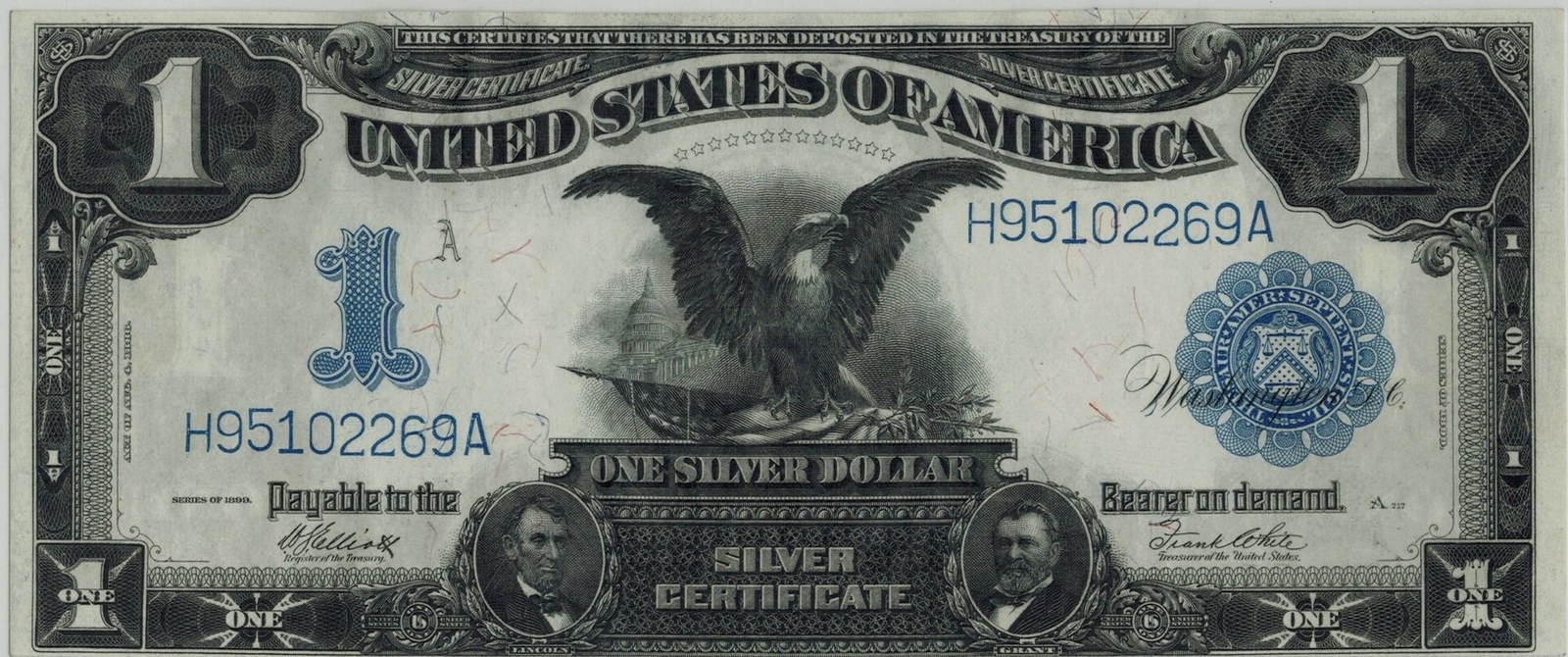
The Black Eagle $1, Fr. 226, is one of the most recognizable large-size U.S. notes. Other 1899 signature combinations have their own Friedberg numbers.
1928
These are among the earliest small-size Silver Certificates. The plain $1 is Fr. 1600.
The transition to the smaller format makes the 1928 issues especially interesting to collectors.
1934
A major small-size Silver Certificate series. The note people usually mean by a 1934 $1 is Fr. 1606. Denomination and series letter change the catalog number — see how much a 1934 Silver Certificate is worth.
Some varieties are much more interesting than others.
1935
Very common overall. The plain $1 is Fr. 1607. Individual varieties, star notes, errors, serial numbers, and high-grade examples can still be collectible.
1957
The final Silver Certificate series. The plain $1 is Fr. 1619.
Extremely common compared with many earlier issues, but still popular with collectors and worth checking for special characteristics.
14. The 1896 Educational Series Is a Special Case
If your Silver Certificate is from 1896, stop before assuming you've found an ordinary old $1.
You may have an Educational Series note.
There are three regular denominations:
- $1
- $2
- $5
The $1 features History Instructing Youth.
The $2 features Science Presenting Steam and Electricity to Commerce and Manufacture.
The $5 centers on Electricity.
These notes are highly sought after for their artwork as well as their historical significance.
For more information, see:
[link internally to: 1896 Educational Series Silver Certificates: The Story Behind America's Most Famous Paper Money]
15. What About the Blue Seal?
The blue Treasury seal is one of the easiest visual clues that you're dealing with a Silver Certificate.
But don't make the mistake of thinking:
“Blue seal = rare.”
The blue seal identifies the type of currency.
It doesn't establish rarity.
Millions of later Silver Certificates have blue seals.
What matters is everything else about the note.
Think of the blue seal as the starting point, not the answer.
16. What About the Blue Serial Numbers?
You'll often see blue serial numbers on Silver Certificates as well.
Again, this is useful for identification.
But blue serial numbers by themselves don't make a note rare.
They're a characteristic of the currency.
The rarity question comes afterward.
17. WWII Silver Certificates Are Worth a Closer Look
There are special Silver Certificate issues associated with World War II that are different from the typical blue-seal notes collectors encounter.
These emergency issues include:
- Hawaii — the $1 overprint is Fr. 2300
- North Africa — the $1 yellow seal is Fr. 2306
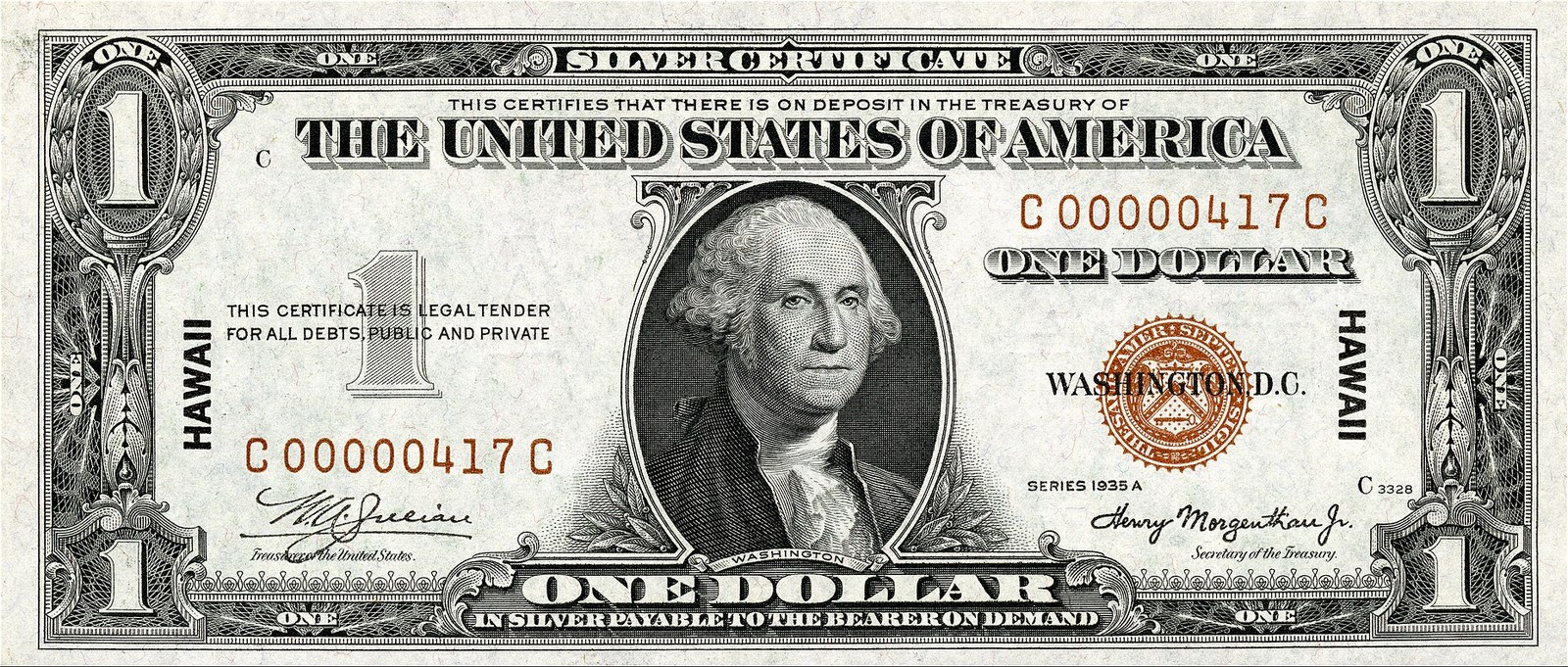
World War II Hawaii overprint on a Series 1935A $1 Silver Certificate.
These were produced for specific wartime circumstances and have distinctive characteristics.
If you find a Silver Certificate with an unusual seal color or wartime design, don't treat it like an ordinary blue-seal $1.
Set it aside and identify it carefully.
18. Don't Rely on Online Asking Prices
This may be the most important part of determining whether your Silver Certificate is actually valuable.
Search online and you'll find Silver Certificates listed for all kinds of prices.
That doesn't mean those prices represent the market.
A seller can list a note for $500.
Someone else can list an identical-looking note for $5,000.
Neither listing proves that anyone will pay those amounts.
What you really want is completed sales.
Actual sales provide evidence of what someone was willing to pay for a particular item under particular circumstances.
And the closer the comparable sale is to your note, the more useful it becomes.
19. Compare Apples to Apples
Suppose you have a:
1935 $1 Silver Certificate
Don't compare it to:
1896 $1 Educational Series
They're both Silver Certificates.
That's about where the similarity ends.
Likewise, don't compare a circulated note with a pristine graded example and assume the difference represents pure rarity.
When researching your note, try to match:
- Series
- Denomination
- Variety
- Signature combination
- Star/regular status
- Serial-number characteristics
- Condition
- Certification
- Major errors or special features
The more closely the notes match, the better your comparison.
20. The Best Question Isn't “What Is It Listed For?”
Instead ask:
“What did comparable examples actually sell for?”
That's a much better way to approach collectible currency.
A marketplace listing tells you what a seller wants.
A completed transaction tells you what a buyer actually paid.
Those can be very different numbers.
On Rarity Ledger the order is the catalog match first — search or a photo, which you confirm — and then the auction lots joined to that ID. Buy It Now prices on auction sites, including eBay, are included. Retail and dealer shop prices are not, and the page does not fill in a price it does not have.
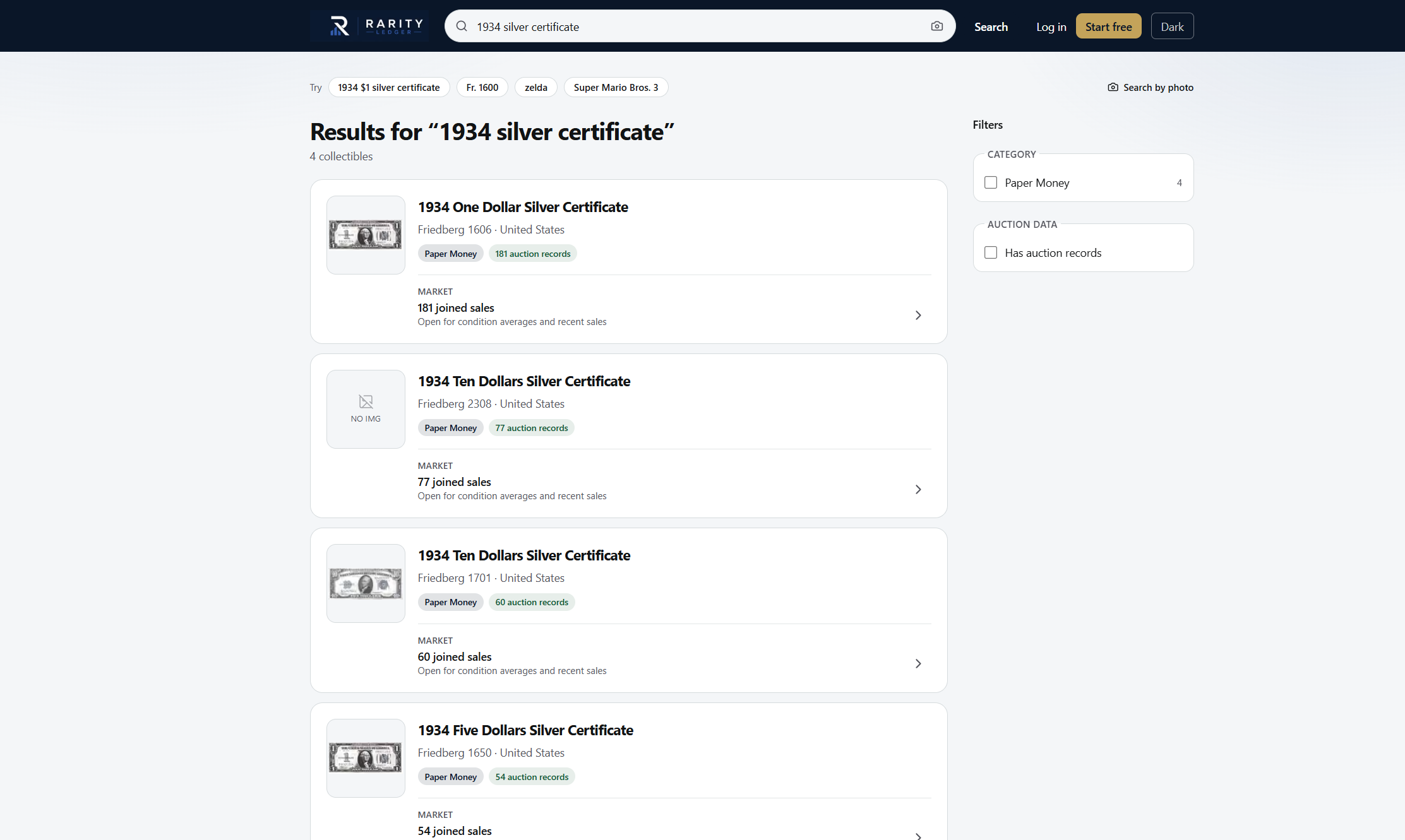
Search results for a 1934 Silver Certificate. Each row is a catalog match.
21. A Quick Silver Certificate Rarity Checklist
If you have a Silver Certificate in front of you, run through this checklist.
Identification
☐ Is it actually a Silver Certificate?
☐ What denomination is it?
☐ What is the series date?
☐ Is there a letter after the series date?
Design
☐ Is it large-size or small-size?
☐ Does it have a famous design?
☐ Is it an 1896 Educational Series — $1 Fr. 224, $2 Fr. 247, or $5 Fr. 268?
☐ Is it an 1899 Black Eagle, Fr. 226?
☐ Is it a wartime Hawaii $1, Fr. 2300, or North Africa $1, Fr. 2306?
Serial Number
☐ What is the complete serial number?
☐ Is there a star?
☐ Is it unusually low?
☐ Does it have a repeating or patterned number?
Condition
☐ Is it heavily circulated?
☐ Does it have folds?
☐ Does it have tears?
☐ Does it have stains?
☐ Does it have writing?
☐ Are the corners sharp?
☐ Does the paper appear original and undamaged?
Other Details
☐ What are the Treasury signatures?
☐ Are there unusual printing characteristics?
☐ Could it be an error?
☐ Is it certified?
If you've checked all of these, you're much closer to determining whether you have an ordinary collectible or something genuinely unusual.
22. What Should You Do If You Think Your Silver Certificate Is Rare?
First:
Don't alter it.
Don't clean it.
Don't press it.
Don't laminate it.
Don't tape it.
Don't write on it.
Don't remove it from an old holder if doing so could damage the note.
Instead, document it.
Take clear photographs of:
- The entire front
- The entire back
- The serial number
- The series date
- The seal
- The signatures
- Any unusual feature
- Any damage
Then research the exact note.
If the note appears genuinely rare or valuable, consider professional authentication and grading before selling it.
23. Can You Tell if a Silver Certificate Is Rare From a Photograph?
Often, yes—at least enough to narrow down what you're looking at.
A good photograph can reveal:
- Series
- Denomination
- Design
- Seal
- Serial number
- Star note status
- Major varieties
- Obvious damage
- Potential errors
But a photograph isn't always enough to determine condition precisely.
Paper quality, folds, repairs, subtle discoloration, and other characteristics can require close physical examination.
So think of identification as the first step.
Identification → research → market comparison → professional evaluation if warranted.
A photo can get you to the catalog row. It still will not grade the paper for you.
The Bottom Line: How to Tell if a Silver Certificate Is Rare
If you remember only one thing, remember this:
Don't judge a Silver Certificate by its age.
Instead, look at the entire note.
Check the:
Series.
Denomination.
Size.
Design.
Serial number.
Star status.
Signatures.
Condition.
Errors and varieties.
Then—and only then—look at the market.
A common 1957 $1 Silver Certificate may be an interesting piece of American history without being rare.
A 19th-century large-size certificate may deserve considerably more attention.
A star note, unusual serial number, rare variety, exceptional-condition example, or genuine printing error can change the picture again.
And the most reliable way to understand the market isn't to find the highest price someone is asking.
It's to find what comparable notes have actually sold for.
Image credits
U.S. currency images are public-domain works of the United States government (Bureau of Engraving and Printing), reproduced from Wikimedia Commons and the National Numismatic Collection at the Smithsonian Institution. Product screenshots are original to Rarity Ledger.