
How Much Is Pokémon Red Worth?
Loose, complete, and sealed are different items. So are Red, Blue, and a later reprint. Identify the copy before you price it.
Pokémon Red is one of the easiest Game Boy games to find and one of the easiest to mis-price.
It sold in the millions. Loose cartridges still turn up in plastic bins. Complete copies and factory-sealed copies sit on a different tape entirely. First-print boxes are not the same item as later prints. And a cart that looks right can still be a reproduction.
The question is what your Pokémon Red is worth. That is not a single number. It is which release you have, how complete it is, and what copies like it have actually sold for.
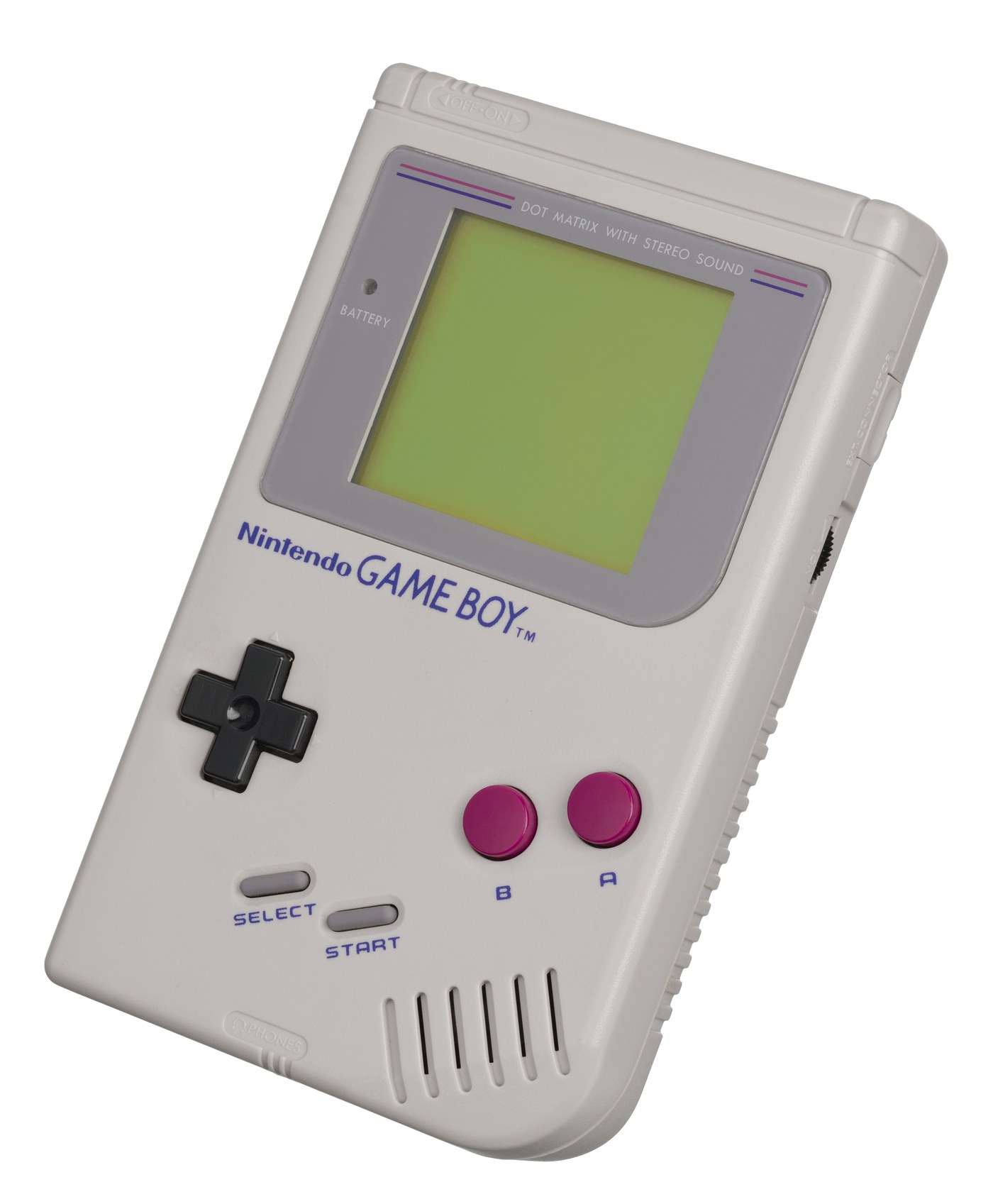
The hardware Red was designed for. Photograph by Evan-Amos, public domain. The game is a separate catalog item from the console.
The short answer
A loose, authentic U.S. Pokémon Red cartridge is a common survivor of a huge print run. It is collectible. It is not a sealed grail.
A complete-in-box copy — cart, box, manual, and the inserts that belong with that print — is a different market. The box and paperwork are what most of the value is sitting on.
A factory-sealed copy is another market again. Graders and first-print status split that tier the way seal type splits an NES box.
Pokémon Red Version and Pokémon Blue Version are not one price. Pokémon Yellow is a third Game Boy SKU. Later Game Boy Color games — Gold, Silver, Crystal — are later catalog rows. Fame does not merge them.
On Rarity Ledger the Red page estimates Complete in Box from joined single-item sales, and shows a sealed figure far above that. Loose sales in the graded tape are sparse — that is a category problem, not a missing cart. Those estimates move when the comps move. They are not a bid for the copy in your drawer.
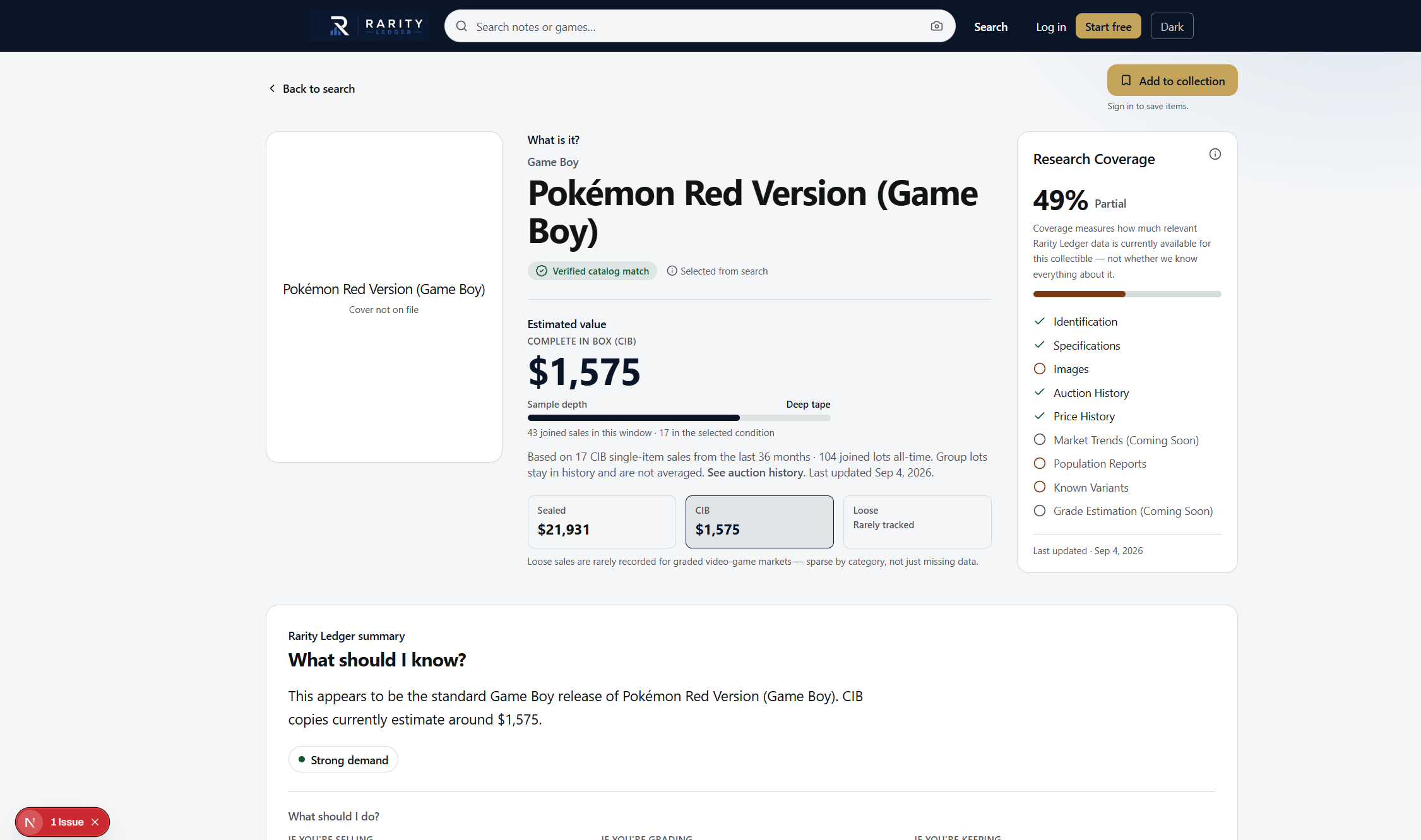
Identity, then joined lots. Sealed, CIB, and loose are separate condition rows on the same title.
First: which Pokémon game is it?
The label on the cartridge is the start, not the finish.
Red and Blue launched together in North America in 1998 as Game Boy titles (they also run on Game Boy Color). They are two SKUs. Catching version-exclusive Pokémon does not merge them. The box art and the cart label tell you which SKU you have.
Yellow is the later “Special Pikachu Edition.” Different box, different cart, different comps.
Gold, Silver, and Crystal are Game Boy Color games. A Crystal cart in a Red box is not a complete Red. A Red cart in a generic Game Boy box is not a complete Red.
Region matters. A Japanese Pocket Monsters Aka is not the North American Red. European and Australian boxes have their own ratings and text. Price the region you hold.
If the label says Red and the board, screws, or stamp look wrong, stop. Reproduction carts are common on this title because demand is high and the original is famous. Authenticity belongs in its own check, later in this article — not in a how-to for fakes. If anything about the board, the plastic, or the stamp feels off, treat the copy as unconfirmed until you compare it to a known original or a grader.
Completeness is the price
For Pokémon Red, condition language that collectors actually use:
| What you have | What it means | Where it sits |
|---|---|---|
| Loose cart | Cartridge only | Lowest tier; still needs to be authentic |
| Cart + box, or cart + manual | Partial | Between loose and CIB; missing pieces are not “close enough” |
| Complete in box | Cart, box, manual, and inserts that belong to that print | The liquid collector tier |
| Factory sealed | Unopened retail seal | Highest tier; print and grader notes split it |
A box-only sale is not a CIB sale. A manual-only sale is not a CIB sale. A cart tested with a fresh battery is not the same listing as a cart that will not hold a save. A dead battery is expected on a late-1990s Pokémon cart. It is not, by itself, a different SKU.
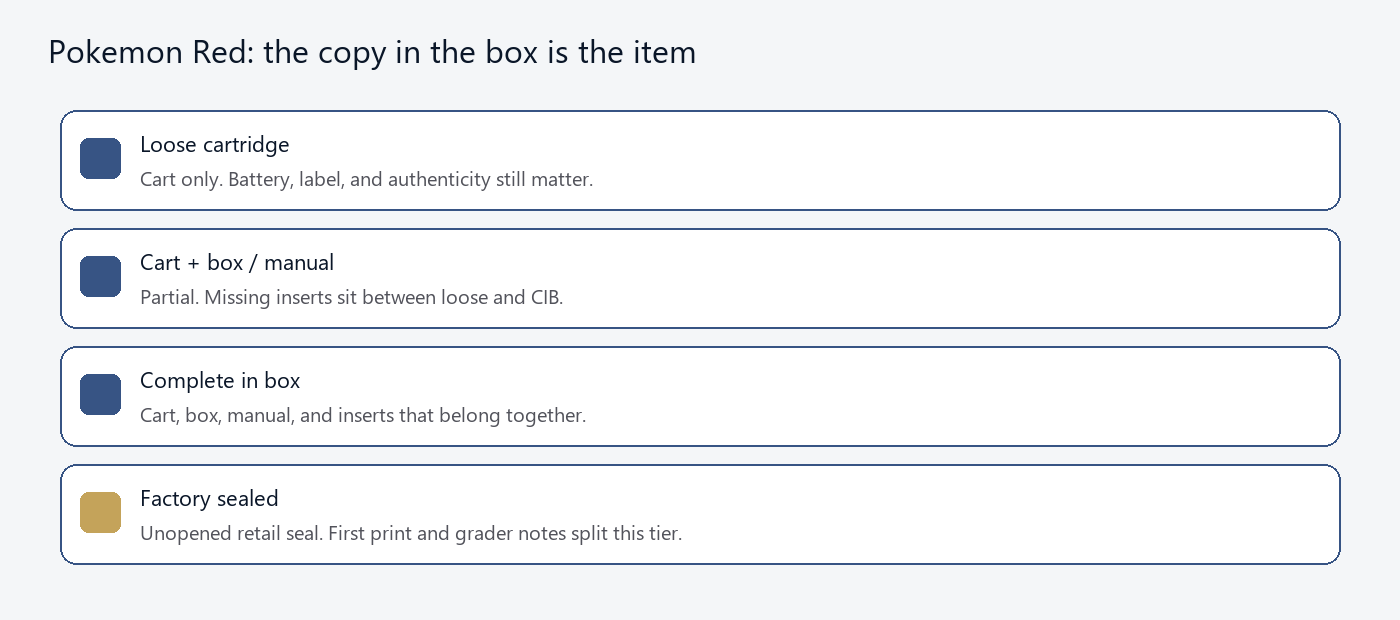
The copy in the box is the item. A cart without the box is not priced off a sealed slab.
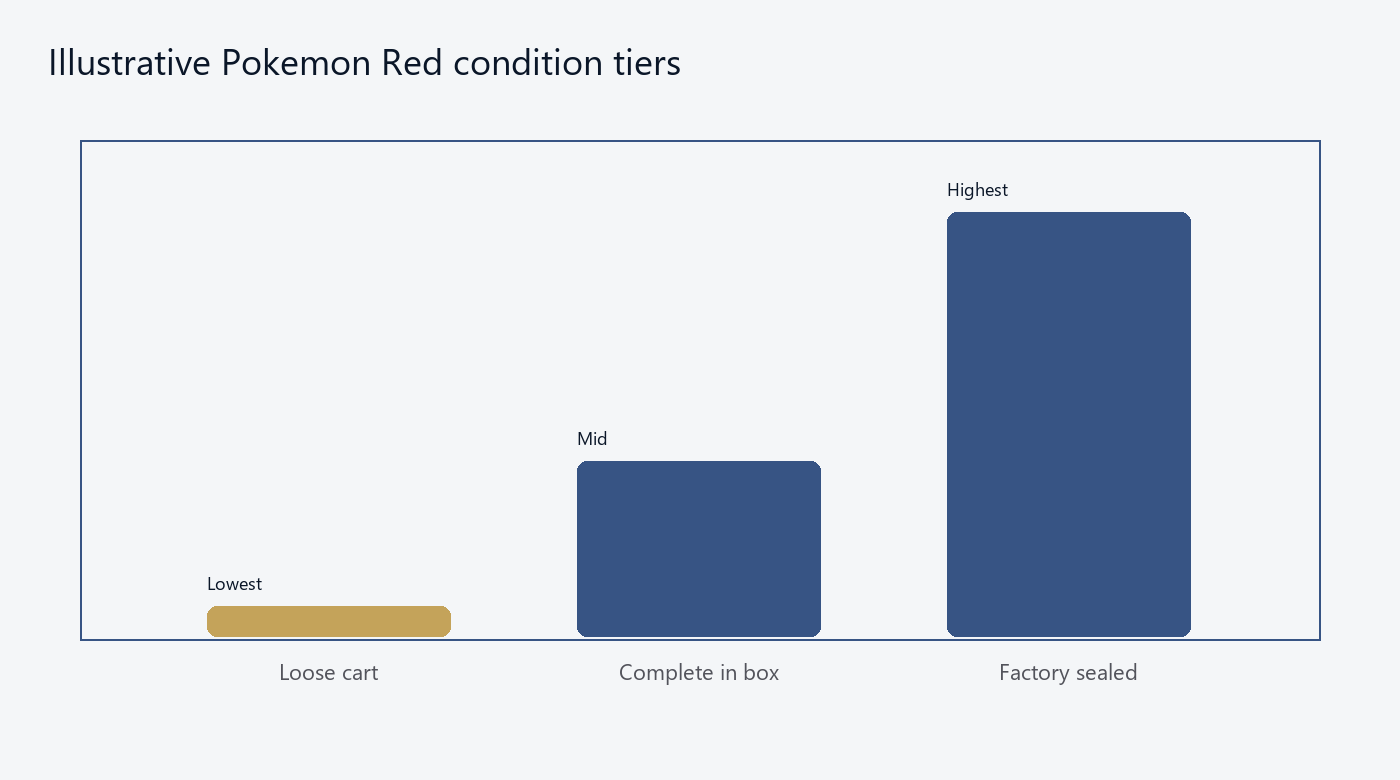
Illustrative shape — not a quote. Sealed and loose do not share a price.
The Red item page makes the spread visible in joined sales: CIB estimates in the low thousands on a recent sample, sealed estimates in the tens of thousands, and loose barely represented in the graded tape. Individual lots on that page have included a first-print sealed sale far above a mid-grade CIB slab from the same month. That is the point of reading the lots. One high sealed hammer is not “what Red is worth.” It is what one graded sealed copy sold for.
First print versus later print
Collectors treat early North American Red and Blue boxes as a separate chase.
Tells live on the box and in the paperwork, not in the Pokémon on the label. First-print boxes and later reprints can look alike on a phone photo. Differences collectors use include the ESRB presentation, the Pokémon shown in the back-of-box screenshots, and whether inserts are the early glued style or later revisions. Graders often note the print on the label.
If you cannot confirm the print, do not price a copy as first print. A later-print CIB is still a CIB. It is not a first-print CIB.
Blue has its own print tree. Do not price a Red first print off a Blue later print.
Sealed is its own problem
A sealed Pokémon Red is where most of the money in this title lives.
It is also where most of the arguments live. Seal type, inner-flap tightness, yellowing, crushing, and whether the box is a first print all show up in grader notes. A “sealed” listing with a reseal, a collector seal, or a damaged wrap is not a factory-sealed sale.
If the wrap is open, the copy is CIB or worse. Do not average it into sealed comps.
WATA, VGA, CGC, and PSA are not interchangeable labels. When you compare sales, match the company and the grade, and read the qualifier line. A sealed 8.0 and a CIB 9.6 are not the same object. Recent joined lots on the Red page have shown exactly that split: a sealed copy in the mid-five figures next to CIB slabs in the hundreds to low thousands.
What about Blue and Yellow?
People ask for Red and then hold Blue.
Blue is the paired launch SKU. Completeness rules are the same. Print variants are not the same list. Sealed Blue and sealed Red do not have to trade in lockstep.
Yellow came later and had its own print run and its own boxed extras. A Yellow CIB is not a Red CIB with different art.
If you have all three Game Boy versions, you have three item pages.
Later Pokémon games are not “the rest of Red”
Gold and Silver are Game Boy Color. Crystal is the third game in that generation. They have infrared, different boxes, and a different collector base.
Pokémon Stadium on Nintendo 64 is a console game that used Transfer Pak saves. It does not price a Game Boy cart.
The same franchise logic that applies to Mario applies here. Super Mario Bros. and Super Mario Bros. 3 are different NES items. Red and Crystal are different handheld items. The complete guide to vintage video game collecting is the longer version of that rule.
Authenticity, batteries, and the listing language
Authenticity. Reproductions exist because Red is famous. Compare the cart plastic, label print, board, and stamps to a known original. If you are buying, buy from a returnable sale or a slab. If you are selling, photograph the back of the cart and the board if you have opened it. This site will not publish a counterfeit recipe.
Battery. Original save batteries die. A replaced battery can be a plus for a player and a note for a collector. It does not turn a loose cart into a CIB.
“Works.” A working cart is the baseline, not a premium, unless the listing is for a parts machine.
“Rare.” Red is one of the most printed handheld games of the 1990s. Scarcity lives in sealed high-grade first prints, not in the name on the label. The NES hobby makes the same mistake; the collector's guide to vintage NES games is the same lecture on a different box.
How to value the copy you actually have
- Name the SKU: Red, Blue, or Yellow; region; Game Boy, not a later remake.
- Name the completeness: loose, partial, CIB, or factory sealed.
- Name the print if you can do it from the box and inserts. If you cannot, leave it unknown.
- Photograph the cart label, the back of the cart, the box faces, and the manual. Sealed copies need the seal edges.
- Match the catalog row. Pokémon Red Version is the Game Boy release this article is about.
- Compare sold lots in that completeness and grade. Ignore the highest ask.
On Rarity Ledger that order is a catalog match you confirm — search or a photo — and then the auction lots joined to that ID. Buy It Now prices on auction sites, including eBay, stay in the estimate. Retail and dealer shop prices do not. If a condition row has no comps, the page does not invent them.
A checklist for the copy in your hand
☐ Red, Blue, or Yellow — and which region?
☐ Loose, partial, CIB, or factory sealed?
☐ Do the box, cart, and manual belong together?
☐ First print or later print — or unknown?
☐ Does the cart look original?
☐ Have I looked at sold lots in this condition, not listing prices?
If the copy is sealed or a first-print CIB, do not throw the box in a closet on its side. Keep it out of sun and humidity. Then read the tape for that row.
If you want the match from a photo, start on Rarity Ledger. Confirm Pokémon Red. Read the lots. Identity first, then the hammers.
Image credits
Game Boy photograph by Evan-Amos, released into the public domain (Wikimedia Commons). Charts and product screenshots are original to Rarity Ledger. Pokémon cartridge and box art are not reproduced here.