
How to Tell if a Comic Book Is Valuable
Age is not a key. Title, issue, printing, and sold comps are. A checklist for the book in the long box.
A long box of old comics looks like a treasure hunt.
Most of the books in it are not.
The market runs on key issues. Value concentrates in a specific issue — a first appearance, a first issue, an origin, a landmark event — and then splits again by printing, edition, and grade. A 1970s superhero book that sold hundreds of thousands of copies can be a two-dollar reader. The first appearance three titles over can be the only book in the box that matters.
The question is whether this comic is worth anything. Identify the exact book, then look at what copies like it have actually sold for. Age, nostalgia, and a listing that says “rare” are not the test.
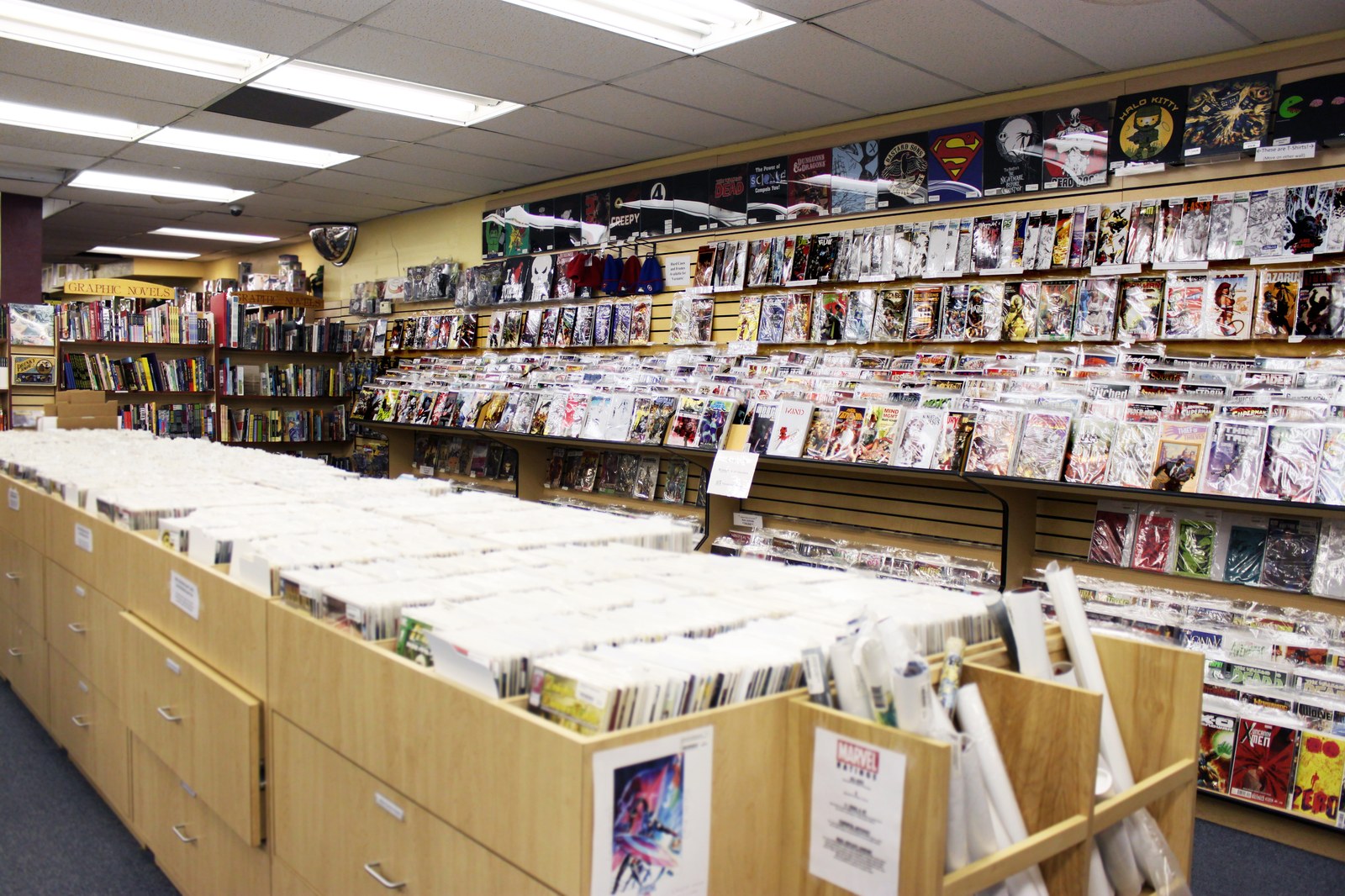
Most of a shop is inventory, not keys. Photograph by Emily Byers, Adventures Underground, Richland, Washington. CC BY-SA 3.0.
The short answer
A comic is valuable when collectors consistently pay a premium for that specific issue, in that printing, in that condition.
It is not valuable because it is old.
It is not valuable because you remember the character.
It is not valuable because a reprint used the same cover.
Three books that look related can be three different catalog rows:
- Amazing Fantasy #15 (1962) — first appearance of Spider-Man
- The Amazing Spider-Man #1 (1963) — first issue of the ongoing series
- A later Amazing Fantasy or Amazing Spider-Man that reused the number
If you search “Amazing Fantasy 15 worth,” and you have a later series or a reprint, you are pricing the wrong book.
What collectors mean by a “key”
A key issue is a book the market treats as significant. There is no official stamp. Price guides, graders, dealers, and completed sales converge on a list, and that list can move.
Common reasons a book is a key:
- First appearance of a character who later mattered
- First issue of a series that lasted
- Origin told for the first time
- Costume, team, or title change that collectors still chase
- Iconic cover that people buy as art, independent of the story
- Death or event that the market decided to keep paying for
First appearance is the loudest category. It is also the easiest to get wrong.
Cameos and first full appearances are not always the same issue. Wolverine’s first cameo and first full appearance are a famous split; graders and guides have not always used the same language. If two references disagree, that disagreement is information. Expect a split market, and do not price a cameo off a full-appearance sale.
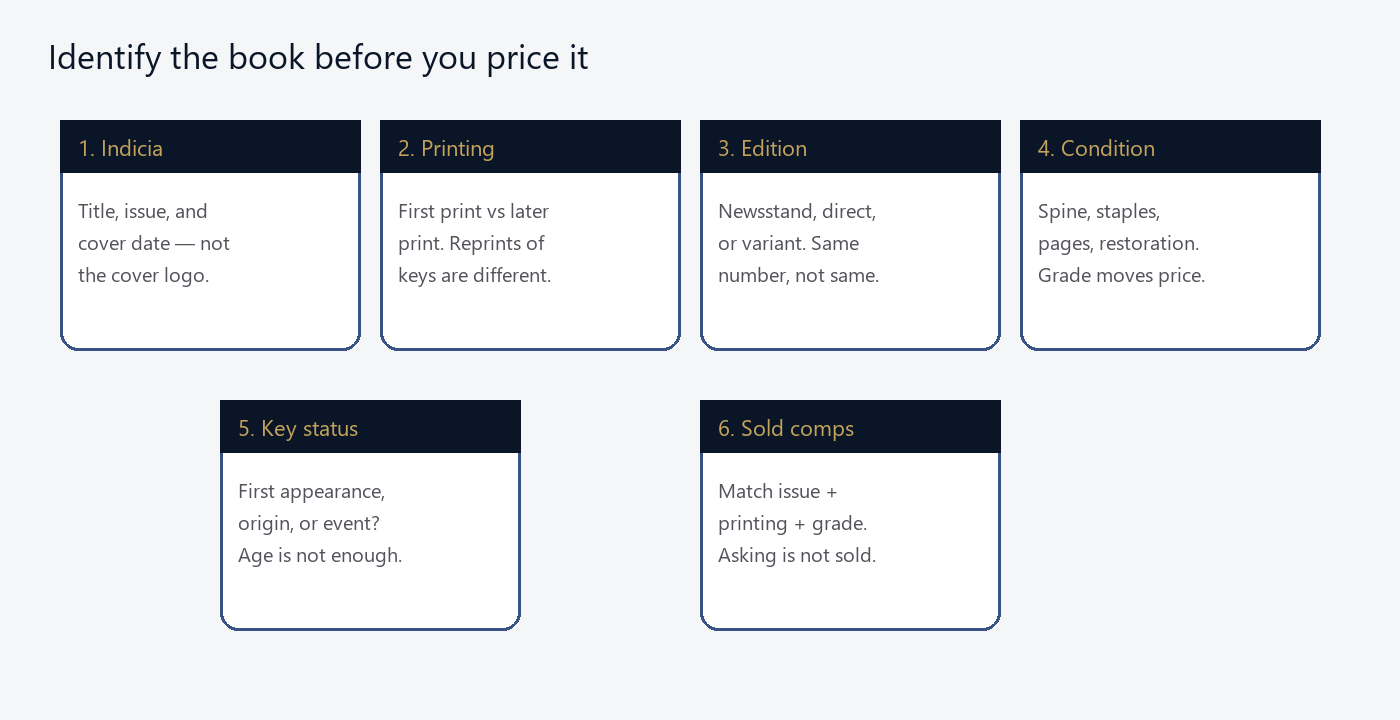
The order does not change: indicia, printing, edition, condition, key status, then sold comps.
Step 1. Read the indicia, not the cover logo
The indicia is the small legal text, usually inside the front cover or on the first story page. It is the identity of the book.
From the indicia you want:
- Publisher
- Series title
- Issue number
- Cover date or publication date
- Volume, if the publisher restarted numbering
The cover logo can lie. Homage covers, variant covers, and later series reuse famous trade dress on purpose. The indicia is the catalog row.
Write those facts down before you search. “Old Superman comic” is not a search. Action Comics #1 (1938) is a search. Detective Comics #27 (1939) is a search. A later Detective Comics with the same number is a different book.
Step 2. Confirm the printing
Keys get reprinted. Reprints get sold as if they were the original.
Later printings of a first appearance are usually worth a fraction of the first print. Some have a printing statement in the indicia. Some have a cover price, barcode, or interior-page difference. Some 1990s “second prints” are marked clearly; some Silver Age reprints are not.
If you cannot tell the printing, you cannot tell the price. A first-print Amazing Fantasy #15 and a later reprint that used the Ditko cover are not the same item.
Facsimiles and modern reprints exist specifically to look like the original. Check the date, the paper, the barcode, and the publisher line. If it says “facsimile” anywhere, price it as a facsimile.
Step 3. Newsstand, direct, and variants
From the late 1970s on, many issues exist as direct edition (comic shops) and newsstand (grocery and drugstore copies with a UPC).
For a long time newsstand was the default. By the 1990s the ratio flipped. On some modern keys, the newsstand UPC copy is the scarcer edition and brings a premium. On others, a particular variant cover is the chase and the newsstand is ordinary.
The rule is the same as paper-money series letters: same issue number, different edition, different comps.
Variant covers, polybagged editions, and retailer exclusives need their own sales. Do not average a 1:100 variant into the regular-cover tape.
Step 4. Condition is most of the remaining price
Once the issue is identified, grade does the rest.
Comics are unforgiving. Spine ticks, color-breaking creases, rusty staples, moisture waves, writing, missing coupons, and amateur tape all move a book down a band. Page quality — white, off-white, cream, tan — shows up on labels and in bids.
A mid-grade copy of a major key can still sell for far more than a high-grade common book. The key status sets the floor. The grade sets the spread.
Restoration is its own problem. Cleaning, color touch, piece fill, and glue are not “taken care of.” Graders will note them. Buyers discount them. If a raw book looks too clean for its age, that is a reason to pause, not a reason to add a premium.
Third-party grading (CGC and others) is a cost. It makes sense when the likely graded value is several times the fee, and when buyers of that book actually want a slab. It does not make sense for a cheap reader.
Step 5. Look at sold comps for that book
Price guides are a starting map. They are not the tape.
A completed sale tells you what a buyer paid for a specific grade and edition. A listing tells you what a seller wants. Those numbers can be far apart, especially on keys after a movie announcement.
Compare like to like:
- Same series and year, not just the same title words
- Same issue
- Same printing
- Same edition (newsstand / direct / variant)
- Same grade band, or the same slab grade
- Single-book lots, not group lots
On Rarity Ledger that comparison starts with a catalog match you confirm — search or a photo — and then the auction lots joined to that ID. Buy It Now prices on auction sites, including eBay, are included. Retail and dealer shop prices are not. If a grade has no comps, the page leaves them missing.
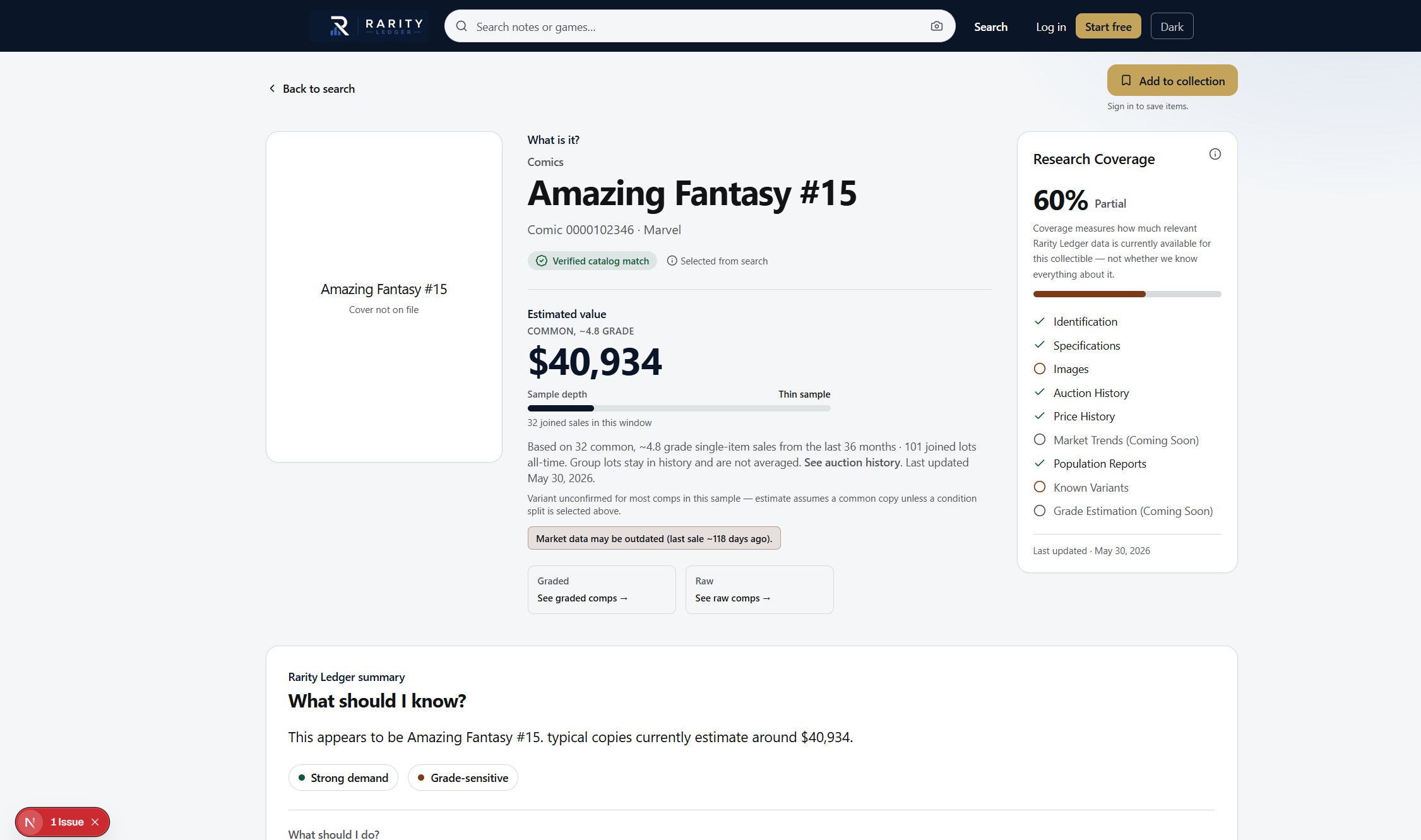
The 1962 Amazing Fantasy #15 page: identity, then joined sales and a graded population. The estimate is a sample of comps, not a bid for your raw copy.
That page is a useful worked example of how keys actually trade. Joined reports show thousands of graded copies, with the population stacked in mid and low grades — 3.0 is a common slab, not 9.8. Recent single-book sales in the mid-grade bands have been in the five figures. A one-point grade change in that range can move the hammer by as much again. Almost none of the graded population sits at the top of the scale. That is what “grade-sensitive” means on a real key. It is not a price for the book in your closet. It is why you do not price a 2.5 off a 5.5.
Famous keys — and why they are easy to mis-ID
These are books people mean when they ask the question. Each one is a catalog row, not a vibe.
Golden Age firsts. Action Comics #1 (Superman). Detective Comics #27 (Batman). These are museum-level keys. Reprints, later series, and “looks like” covers are everywhere. If you think you have one, the indicia and a professional look come before any number you saw in a headline.
Silver Age firsts. Amazing Fantasy #15. The Amazing Spider-Man #1. Showcase #4 (Flash). Tales of Suspense #39 (Iron Man). Same warning: later series reused the numbers.
Bronze Age firsts. The Incredible Hulk #181 (Wolverine’s first full appearance). Giant-Size X-Men #1 (the new X-Men). These show up more often than Golden Age books and still get confused with later reprints and #180 cameos.
Modern keys. First appearances from the 1990s and 2000s can be valuable. They can also be books that were printed for the speculator market and never recovered. Print run and demand both have to show up in the sales. A foil cover is not a first appearance.
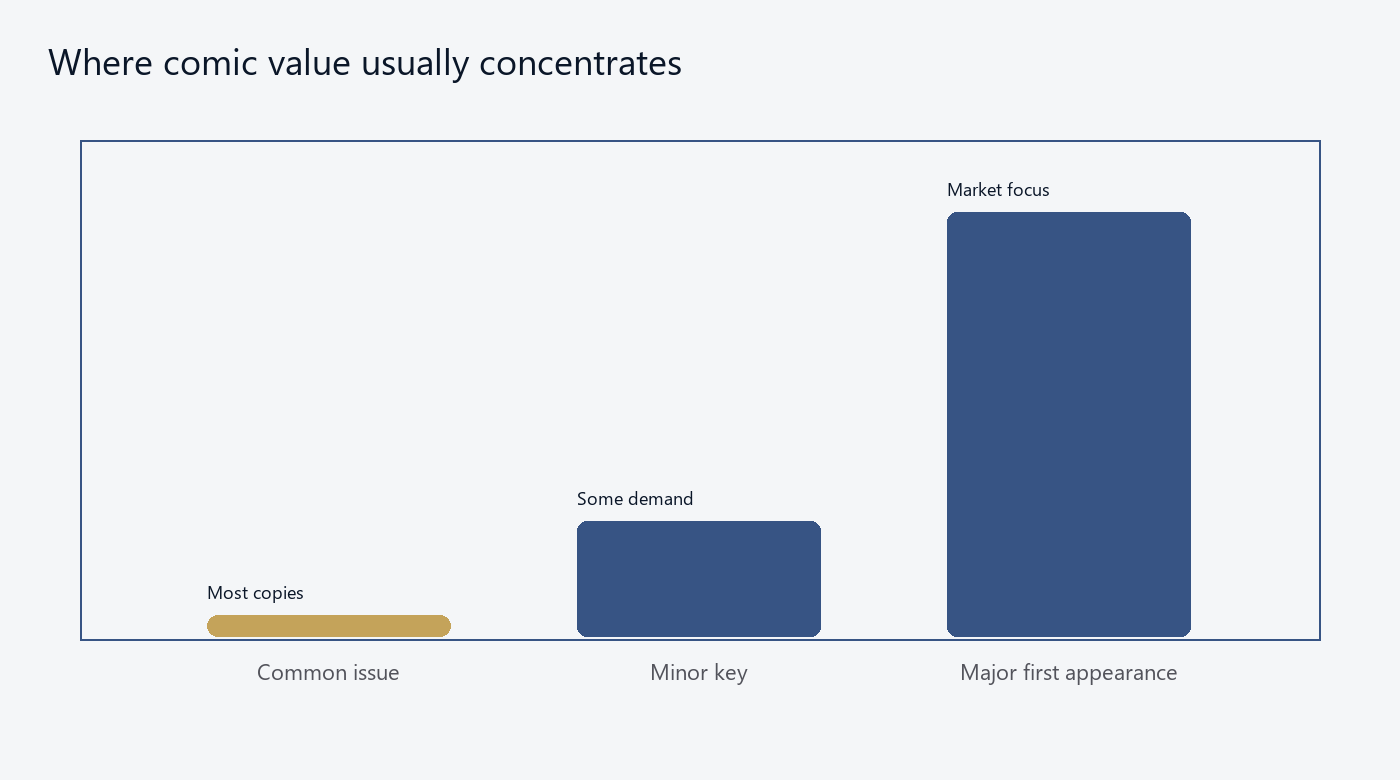
Illustrative shape — not a quote. Most issues sit on the left. The market pays attention to the right.
What does not make a comic valuable
Age. A 1985 X-Men that sold in the hundreds of thousands is old. It is not scarce.
A movie. Adaptations move demand. They do not change the print run. When the movie cycle ends, the comps are what remains.
A big number on a listing. One ask is not a market.
“Signed by the artist” in ballpoint on the cover. Unless the signature is authenticated in a way buyers of that book accept, it is often a defect.
A complete run of common issues. A run can be worth something as a lot. It is not worth the key-issue price times the number of books.
A checklist for the book in your hand
☐ Publisher, title, issue, and date from the indicia
☐ First print, later print, or facsimile?
☐ Newsstand, direct, or variant?
☐ Spine, staples, pages, moisture, writing, restoration?
☐ Is this actually a first appearance, first issue, or origin — or a later series with the same number?
☐ Have I looked at sold copies in this grade, not asks?
If the book might be a real key in collectible condition, stop stacking it in a raw long box. Bag and board it. Keep it flat. Then decide whether grading is worth the fee.
If you want the catalog match from a photo, start on Rarity Ledger. Confirm the issue. Read the lots joined to that ID. Identity first, then the hammers.

Most books on the table are readers. A few are keys. Photograph of The Beguiling, Toronto, by Bryan Partington / striatic. CC BY 2.0.
Image credits
Shop interior: Emily Byers, View of Comic Books in Adventures Underground, Richland WA, Wikimedia Commons, CC BY-SA 3.0. Storefront: Bryan Partington, The Beguiling - Free Comic Book Day, Wikimedia Commons, CC BY 2.0. Charts and product screenshots are original to Rarity Ledger. Comic cover art is not reproduced here.