
USA Silver Certificates: History, Types, and What Your Old Silver Certificate Is Worth
From 1878 through the 1960s, Silver Certificates were a claim on Treasury silver. Today they are collectible paper — identify the series before you price it.
If you have an old American $1, $2, $5, $10, or other paper note that says “Silver Certificate,” you may be holding more than an interesting piece of old currency.
Some Silver Certificates are common and trade close to face value. Others can be worth substantially more to collectors because of their age, rarity, condition, design, signatures, serial numbers, or other characteristics.
The tricky part is knowing which is which.
A Silver Certificate isn't valuable simply because it is old. And despite the name, these notes can't still be exchanged for silver.
They are collectible pieces of American monetary history—and the exact note in your hand matters.
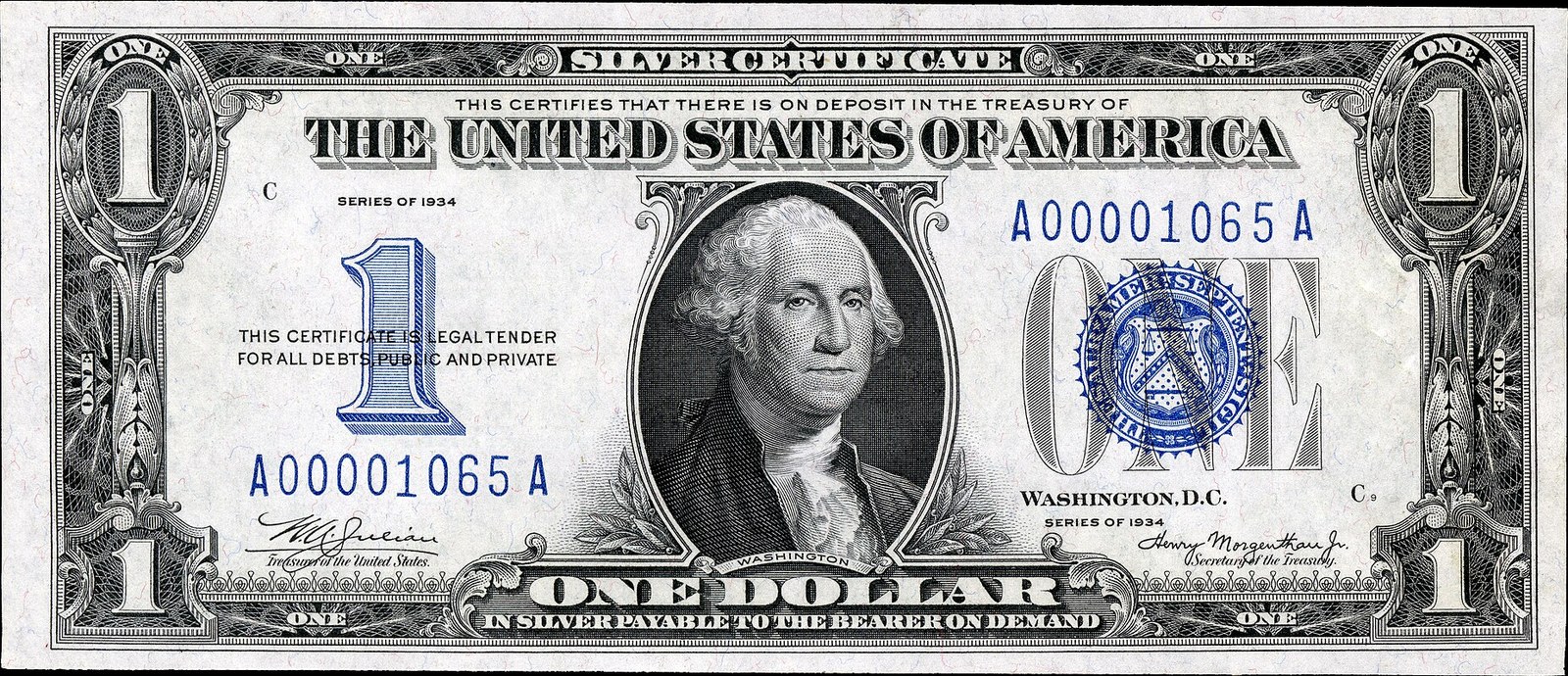
Small-size $1 Silver Certificate. The banner at the top is the tell.
What Is a U.S. Silver Certificate?
A Silver Certificate was a form of United States paper currency that represented silver held by the U.S. Treasury.
The first Silver Certificates were authorized in 1878, following legislation that increased the government's purchase and coinage of silver. The certificates were backed by silver held in the Treasury and originally represented a claim to silver dollars.
In simple terms, instead of carrying silver dollars around, a person could carry a paper certificate representing silver deposited with the government.
Early certificates actually stated this relationship directly.
For example, an 1896 $1 Silver Certificate stated that one silver dollar had been deposited in the Treasury and was payable to the bearer on demand.
That makes Silver Certificates an important part of the transition from physical precious-metal money to the paper currency system Americans use today.
When Were Silver Certificates Issued?
U.S. Silver Certificates were issued from 1878 through the 1960s.
The Bureau of Engraving and Printing identifies 1878 as the beginning of Silver Certificate production. The certificates were gradually discontinued as the relationship between U.S. paper currency and silver changed.
The last Silver Certificates were issued in the 1960s, and the Bureau of Engraving and Printing no longer produces them.
There is an important distinction here:
A Silver Certificate can be old paper money without being redeemable for silver today.
In 1964, the Treasury ended redemption of Silver Certificates for silver dollars. Congress subsequently authorized a one-year period, ending June 24, 1968, during which Silver Certificates could be exchanged for silver bullion. After that period, they could only be redeemed at face value from Treasury funds.
So if you find an old Silver Certificate today, don't assume it represents a claim to a piece of silver.
Its potential value is primarily a collectible value.
Why Are Silver Certificates Collectible?
There are several reasons collectors are interested in Silver Certificates.
Age
Some Silver Certificates are more than a century old.
The earliest issues from the late 1800s are particularly interesting because they come from a completely different era of American currency.
Design
American paper money from the late 19th and early 20th centuries can be dramatically different from modern Federal Reserve Notes.
Some notes feature elaborate engraving, allegorical figures, historical personalities, ornate borders, and unusual layouts.
The 1896 Silver Certificate series, for example, is famous for its elaborate designs and is commonly known as the Educational Series.
The $1 note depicts History Instructing Youth. The $2 depicts Science Presenting Steam and Electricity to Commerce and Manufacture. The $5 features an allegorical representation of Electricity.
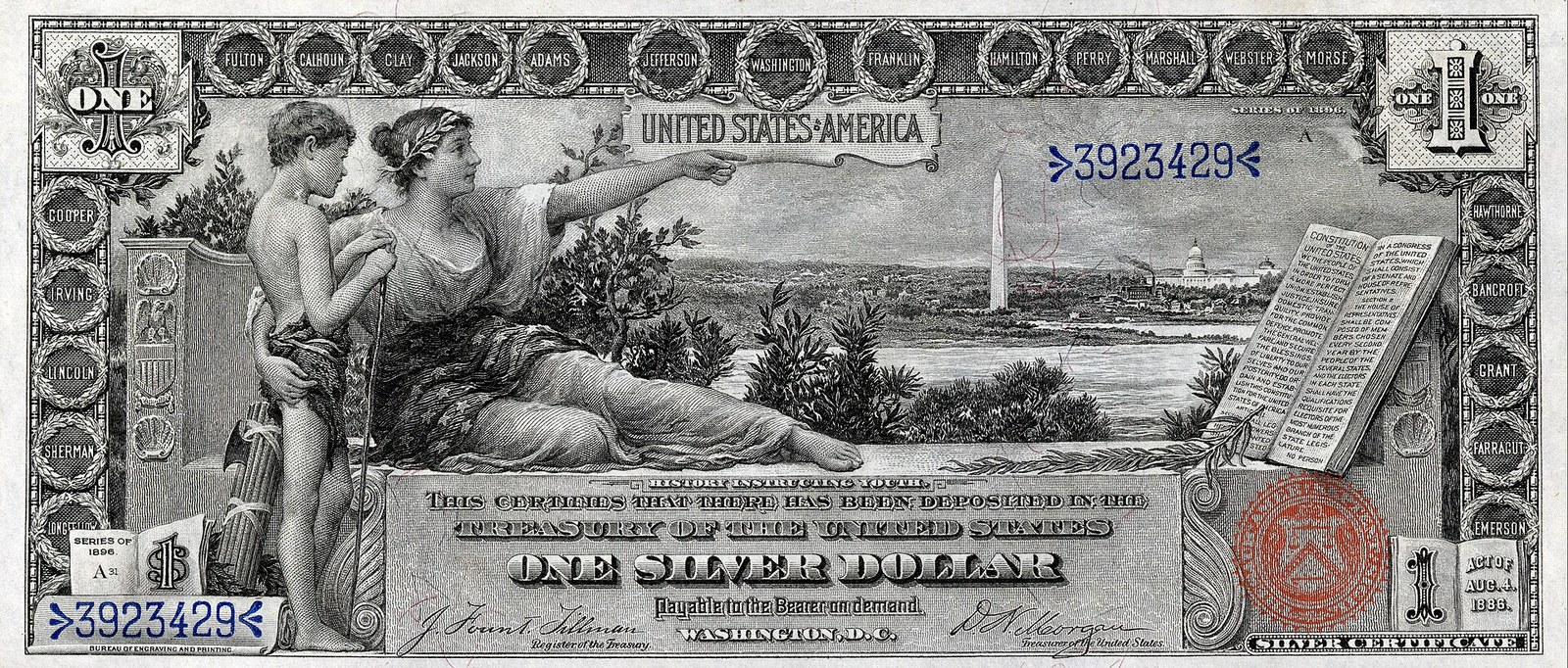
These aren't just pieces of currency. They are examples of American engraving and graphic design. Showcasing beautiful designs.
Rarity
Not every Silver Certificate from a particular year is equally scarce.
Collectors may care about the specific series, denomination, signature combination, serial-number range, printing variety, or other attributes.
Two notes that look almost identical can therefore have very different values.
Condition
Condition can have an enormous impact on collectible paper money.
A heavily circulated note with folds, stains, tears, writing, or other damage can be worth considerably less than an otherwise identical note that has survived in exceptional condition.
Serial Numbers and Other Features
Collectors also look at things such as:
- Serial numbers
- Star notes
- Signature combinations
- Series dates
- Printing varieties
- Seal characteristics
- Errors
- District or other identifying information
- Paper quality
- Overall condition
That's why simply searching for “1899 Silver Certificate” isn't always enough to determine what a particular note is worth.
The details matter.
The Major Types of U.S. Silver Certificates
Silver Certificates changed considerably over the nearly 90 years in which they were issued.
Collectors generally encounter several broad groups.
Large-Size Silver Certificates
Some of the earliest Silver Certificates were much larger than today's U.S. currency.
These are commonly referred to by collectors as large-size notes. Simply, because they are literally larger than what we have today.
Large-size Silver Certificates were issued from the late 19th century into the early 20th century.
Early issues included denominations such as $10, $20, $50, $100, $500, and $1,000. Lower denominations were later authorized, including $1, $2, and $5.
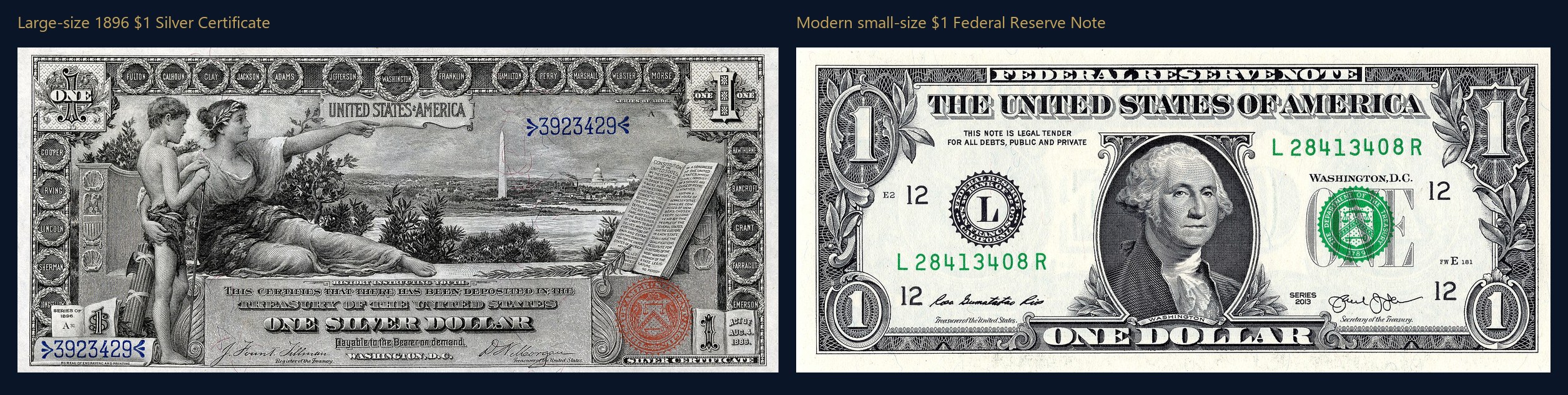
These large notes are among the most visually distinctive pieces of American paper money.
If you find one in an old collection, album, envelope, safe, or inherited group of currency, it is worth taking a closer look before assuming it is worth only face value.
The 1896 Educational Series
Few Silver Certificates are as recognizable as the 1896 Educational Series.
The series included three denominations: a $1 (Fr. 224), a $2 (Fr. 247), and a $5 (Fr. 268). The artwork is allegorical — history, science, commerce, and technology. The longer account is the 1896 Educational Series.
The Smithsonian describes the 1896 Silver Certificates as among the most beautiful American notes ever printed. (And most collectors would agree.)
The $1 is especially famous.
It features History Instructing Youth on the front and portraits of George and Martha Washington on the back.
The $2 features Science Presenting Steam and Electricity to Commerce and Manufacture, with Robert Fulton and Samuel Morse appearing on the reverse.
The $5 features Electricity as the dominant figure and portraits of Ulysses S. Grant and Philip Sheridan on the reverse.
These notes are a great example of why collecting old paper money isn't simply about finding the oldest possible bill.
Sometimes the design itself is part of the appeal.
Silver Certificates With Martha Washington
One of the most interesting facts about American paper money is that Martha Washington appeared on U.S. currency.
She appeared on the $1 Silver Certificate in the 1886 (Fr. 215), 1891 (Fr. 222), and 1896 (Fr. 224) series. Those are three different notes. Martha Washington on U.S. currency is the side-by-side. The Smithsonian's National Museum of American History has examples of these notes in its collection.

For collectors who are unfamiliar with older American currency, a note featuring Martha Washington can look almost unbelievable.
It is legitimate historical U.S. currency—and it is one of the reasons certain Silver Certificates attract so much attention from collectors.
The Transition to Smaller U.S. Currency
If you've ever compared an old Silver Certificate with a modern dollar bill, you've probably noticed a dramatic difference in size.
That wasn't always the case.
Large-size U.S. notes were eventually replaced by the smaller format used today. We call them small-size, because they are smaller than the larger format.
By the 1930s, Silver Certificates were being produced in the smaller size that collectors will recognize from more recent U.S. currency.
For example, a Series 1934 $1 Silver Certificate (Fr. 1606) measures approximately 6.5 by 15.5 centimeters, considerably smaller than the earlier large-size notes.
The smaller notes continued to carry the Silver Certificate designation well into the 1960s.
The 1934 Silver Certificates
The 1934 series is one of the groups collectors commonly encounter. What a date is worth depends on the denomination and the series letter — the walk-through is how much a 1934 Silver Certificate is worth.
The $1 (Fr. 1606) features George Washington and states that one dollar in silver was deposited in the Treasury and payable to the bearer on demand.
By this point, the design of American currency was becoming much closer to what collectors recognize today.
That doesn't mean every 1934 Silver Certificate is rare.
In fact, this is one of the most important lessons when collecting old paper money:
Old does not automatically mean rare.
Millions of older notes have survived.
The value of a specific example depends on exactly what it is and how well it has survived. In other words - how many are around, and what is the condition of the note. Even a note 100-years old can still be found in uncirculated condition. Likewise, a note printed last year could be missing corners and stained -- a much lower condition.
The 1957 Silver Certificate
The 1957 $1 Silver Certificate (Fr. 1619) is another note many Americans encounter.
It is especially recognizable because it was one of the Silver Certificates produced during the final era of the series.
The motto “In God We Trust” first appeared on U.S. paper currency on Series 1957 $1 Silver Certificates.
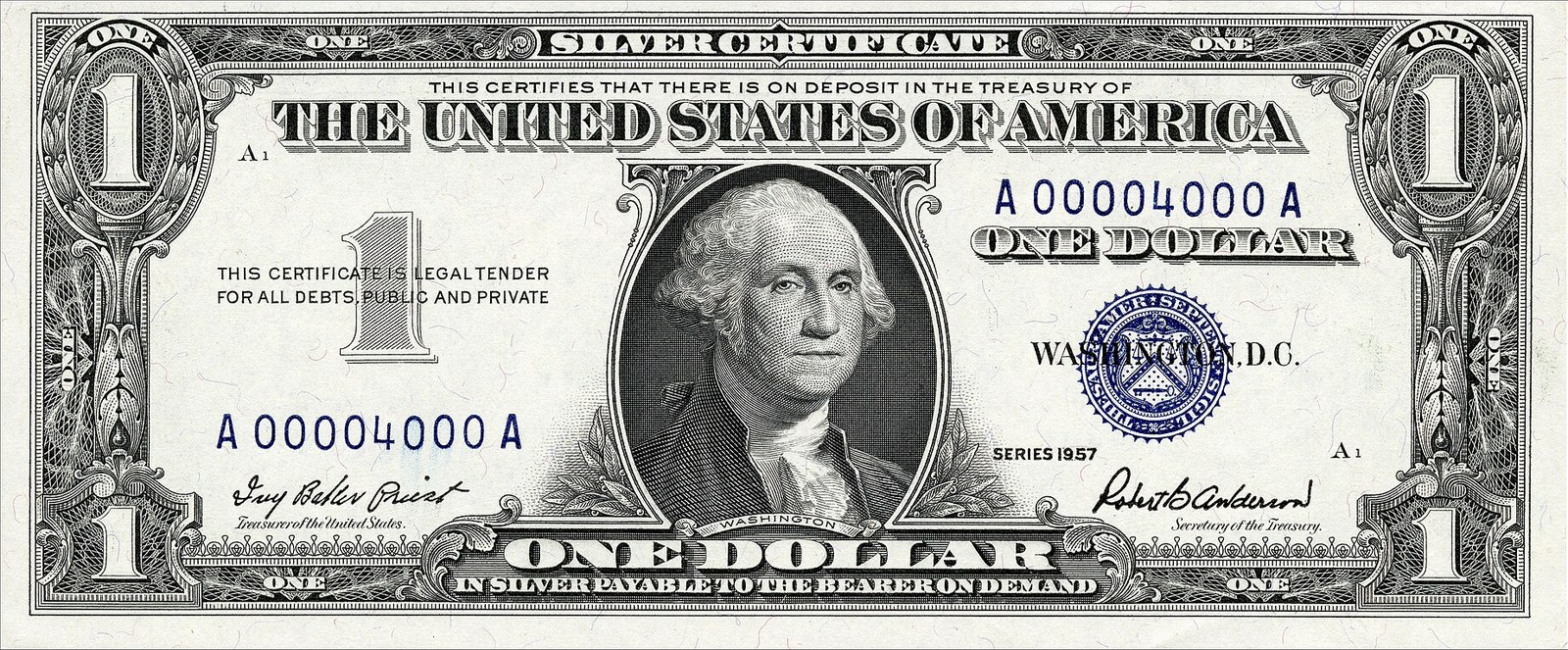
These notes can sometimes be found in collections, old wallets, cash drawers, inherited currency, and boxes of miscellaneous coins and paper money.
Many are collectible.
But again, not every 1957 Silver Certificate is rare or highly valuable.
The specific series, signature combination, serial number, condition, and other characteristics can make a significant difference.
Are Silver Certificates Still Legal Tender?
Silver Certificates are no longer issued, and they are no longer redeemable for silver.
However, they remain recognized as U.S. currency at their face value. A little side note, all USA money printed since 1861 is still redeemable for its face value. But, I wouldn't recommend spending it at your local grocery store.
That doesn't necessarily mean spending one-dollar Silver Certificate for $1 is a good idea.
A collectible note can be worth more to a collector than its face value.
This is one of the most common mistakes people make with old paper money.
A $1 Silver Certificate may be worth $1.
It may be worth several dollars.
It may be worth substantially more.
You have to identify the exact note before you know.
What Makes a Silver Certificate Valuable?
If you have a Silver Certificate and want to know what it is worth, start with these factors.
1. Series
Look for the series or date.
This is usually one of the first pieces of information a collector will want to know.
Don't stop at the year, though.
A note can have additional identifying characteristics that distinguish it from another note with a similar series.
2. Denomination
Is it a:
- $1
- $2
- $5
- $10
- $20
- $50
- $100
- $500
- $1,000
The denomination can dramatically change the collecting landscape.
3. Condition
Look closely at the paper.
Check for:
- Folds
- Creases
- Tears
- Pinholes
- Stains
- Writing
- Missing corners
- Edge damage
- Repairs
- Discoloration
- Overall crispness
A note that has spent decades folded inside a wallet is going to be evaluated differently from one that was stored flat and carefully protected.
4. Serial Number
Record the complete serial number.
Certain serial numbers may be more desirable to collectors, while others can help identify a particular issue or variety.
Also look for unusual serial-number characteristics such as repeating, low, or otherwise distinctive numbers.
5. Star Note
Look for a star symbol in the serial-number area.
A star can indicate a replacement note, commonly called a star note.
Star notes are collected separately from ordinary examples, and their desirability depends on the specific issue and rarity.
6. Signatures
U.S. silver certificates always has the signatures of Treasury officials printed on the note. These can be found near the bottom margin of the note.
Signature combinations can be an important part of identifying and collecting older currency.
Two otherwise similar notes can therefore have different catalog identities.
7. Errors
Look carefully.
Printing errors can be extremely interesting to collectors.
Possible errors can include things such as:
- Misaligned printing
- Missing printing
- Ink problems
- Cutting errors
- Overprint problems
- Serial-number abnormalities
- Other production mistakes
If something about the note looks wrong, don't alter it.
Don't clean it.
Don't trim it.
Don't attempt to repair it.
An unusual feature may be part of what makes the note collectible.
How Much Is My Silver Certificate Worth?
This is the question almost everyone asks after finding one.
Unfortunately, there isn't one universal price for “a Silver Certificate.”
A better question is:
How much have comparable examples actually sold for?
That distinction matters.
An asking price on an online marketplace isn't necessarily what a collector actually paid.
An auction result, however, represents an actual transaction.
For valuable paper money, the difference between an asking price and a completed sale can be significant. One way to think about it is anyone can ask for any price for their note. That is an asking price.
Auctions are a useful barometer because the price goes as high as someone is willing to pay. Notes of similar condition, denomination, and series tend to hammer in a range — not at whatever number a listing asks.
That's why researching real sales of comparable notes is one of the best ways to understand the market.
When evaluating a Silver Certificate, compare notes that match as closely as possible in:
- Series
- Denomination
- Signature combination
- Serial-number characteristics
- Grade or condition
- Major varieties
- Errors
- Certification
- Auction venue
A 1934 $1 Silver Certificate isn't automatically comparable to another 1934 $1 simply because both say “1934.”
The more closely the examples match, the more useful the comparison becomes.
Don't Make This Common Silver Certificate Mistake
One of the easiest mistakes to make is finding an old note online with a huge asking price and assuming your note must be worth the same amount.
It doesn't work that way.
A seller can list a $1 Silver Certificate for $500, $5,000, or $50,000.
That doesn't mean someone will pay that amount.
Collectors and dealers generally want to know what comparable examples have actually sold for.
That's the difference between a theoretical price and a market price.
Should You Get a Silver Certificate Graded?
Sometimes. Depending.
Professional grading can be useful when a note is valuable enough for authentication, condition assessment, and encapsulation to justify the cost.
It can also make buying and selling easier by providing an independent grade and identifying information.
But not every Silver Certificate needs to be professionally graded.
For a common circulated $1 Silver Certificate, the cost of grading may not make economic sense.
For a rare, valuable, high-grade, or questionable note, professional certification can be much more useful.
The key is to understand the approximate market value of the note before deciding whether grading is worthwhile.
How to Identify a Silver Certificate
If you have a note in front of you, start with a simple checklist.
Look at the front
Record:
Denomination:
$1, $2, $5, etc.
Series:
The series date or designation.
Serial number:
Write down the complete number.
Seal:
Note the color and appearance.
Signatures:
Record the Treasury officials if visible.
Look at the back
Look for:
- Major design differences
- Unusual artwork
- Printing characteristics
- Any obvious errors
- Damage or alterations
Then photograph it
Take a clear photograph of both sides.
For the best identification, photograph the note flat in good lighting and make sure the serial numbers and other small details are readable.
This is especially important because many varieties look nearly identical at first glance. Do not clean the note to make the photo look better.
What Should You Do If You Find an Old Silver Certificate?
Don't clean it.
Don't iron it.
Don't laminate it.
Don't tape tears.
Don't trim damaged edges.
And don't throw it away because it looks worn.
Condition is part of the story of paper money, and damage or alterations can affect value.
Instead, identify the note first.
Then research comparable examples.
If you inherited a collection containing multiple notes, resist the temptation to separate or discard everything that looks common.
A collection can contain varieties, star notes, unusual serial numbers, or better-condition examples that aren't obvious at first glance.
Silver Certificates Are More Than Old Money
Silver Certificates tell the story of an unusual period in American monetary history.
They were created when the United States was dealing with major political and economic debates surrounding silver.
They evolved as the country's monetary system changed.
They went from large, ornate certificates representing silver dollars to smaller notes that looked increasingly similar to modern currency.
And eventually, the silver connection disappeared altogether.
The Bureau of Engraving and Printing records billions of dollars of Silver Certificates produced across different denominations during the program's history.
Today, those notes are collected for many different reasons.
Some collectors want the earliest examples.
Some want every denomination.
Some specialize in a particular series.
Some collect famous designs like the 1896 Educational Series.
Others simply want to know whether the old note they found in an attic, drawer, album, or inherited collection is worth more than the number printed on it.
Have a Silver Certificate? Find Out What You Have First.
The most important thing to remember is simple:
Don't value an old note based on its age alone.
Identify the exact note.
Look at the series.
Check the denomination.
Record the serial number.
Examine the condition.
Look for varieties, star notes, errors, and other distinguishing characteristics.
Then compare it with real sales of the same catalog type.
On Rarity Ledger that comparison starts with a catalog match — a search or a photo, which you confirm — and then the auction lots joined to that ID. Buy It Now prices on auction sites, including eBay, are included. Retail and dealer shop prices are not. If the comps are missing, the page leaves them missing.
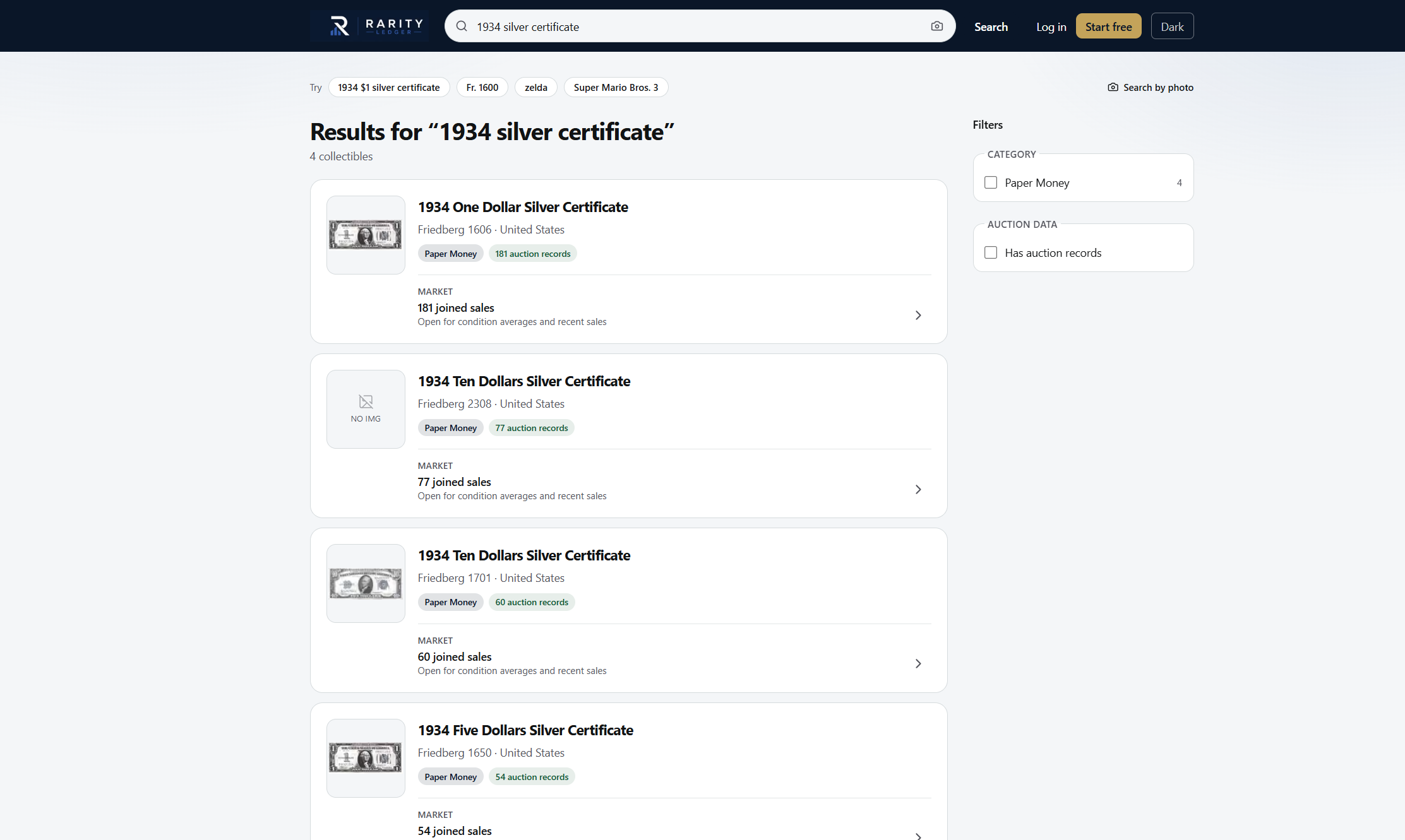
Search results for Silver Certificates. Each row is a catalog match, not a keyword pile.
When you're holding an old Silver Certificate, the question isn't just whether it is old. It is which note it is, and what copies of that note have actually sold for.
Image credits
U.S. currency images are public-domain works of the United States government (Bureau of Engraving and Printing), reproduced from Wikimedia Commons and the National Numismatic Collection at the Smithsonian Institution. Product screenshots are original to Rarity Ledger.